| Yun Li | October 2026 | Non Fiction |
It took me six years to go.
Six years. It is hard now to reconstruct all the ways I postponed the journey. The self I know is impatient and willful, a believer in seizing the day. Yet for six years this one place kept bewitching me, and still I never went near it. Every spring I planned to see it in autumn; every autumn, for no reason I could name, I let the plan fall away. After six cycles, postponement had become a habit. I felt no regret, only a faint sense that the time had not yet come.
Then one day my friend Kankan posted a call on WeChat: Daocheng Yading—who’s coming?
I answered at once: Me.
We assembled a group, chose an itinerary, booked our flights, and set off. I was busy and methodical, not so much excited as serenely certain. This time, I knew, everything had fallen into place. Nothing could stop me.
At last I was going to Daocheng Yading, the place I had dreamed of for years.
I first heard of Daocheng Yading on a tour bus from Jiuzhaigou back to Chengdu. Dazed by the mountain roads, I heard our guide describe “a place more beautiful than Jiuzhaigou.” I forgot the name Daocheng Yading. What I remembered was “the last Shangri-La.”
I had been to the Shangri-La in Diqing, Yunnan, advertised as the “real” one, or perhaps the “eternal” one. It was pretty enough, but I have never cared for words like real and eternal. Such contrived words belong with the least reliable declarations of love. “Last,” though, had a desolate beauty, the air of something standing apart from the world. Jiuzhaigou was already almost more beauty than I could take in. A place more beautiful than Jiuzhaigou—I did not dare imagine it.
Over the next six years I wandered across half the globe without setting foot in Daocheng Yading. I knew it only through hearsay: the hardship and danger, the sheer difficulty of reaching it. Those stories only made it more elusive and precious to me. Whenever I met someone who loved to travel, my first question was always, “Have you been to Daocheng Yading?”
Three weeks before we left, Peter came from Kaohsiung to see friends in Shanghai. Over dinner, I mentioned my trip. Something in my face or voice—too devout, too rapt—must have impressed him, because he immediately asked whether he and his wife could join us.
Looking back, I find that self quite unreasonable. I had never been there, had never even taken the trouble to research it. How could I be so certain of its beauty?
The five of us met in Chengdu, rested for a day, and set out in high spirits. Having endured the altitude at Huanglong and Pudacuo, I romanticized Highway 318: mountains and rivers, one ordeal after another, and still I would emerge fresh-faced at the end.
Instead, I vomited as soon as we reached our guesthouse in Xinduqiao. I told myself it was carsickness. At three the next morning, carrying my luggage out to the bus, I was miserable.
Kankan was worse. She had spent the night feverish and vomiting and now lay limp on the bed, her eyes like those of a wounded animal. For safety, she could go no farther. She would remain in Xinduqiao and wait for a car back to Chengdu.
I wanted to say loyally, “Kankan, don’t be afraid. I’ll go back with you.” In truth, I was dizzy, exhausted, and short of sleep, and every nerve in me was beating a retreat. But Peter and his wife stood beside me, packed and ready, and I could not get the words out.
I was the one who had talked them into coming. They had even changed their flights to avoid a typhoon and meet us in Chengdu. If I abandoned them on this punishing road and ran away, I would deserve to be cursed.
Besides, the dream that had obsessed me for six years was finally within reach. How could I give it up? Sometimes I cannot tell what sort of mountain demon I am—stubborn at heart, feeble in will. At half past three, as I climbed into the cold, dark bus, I was in genuine misery.
It lasted fourteen hours.
I vomited five times. Passing Litang, Tsangyang Gyatso’s line kept circling in my ears: “Atop the eastern hill…” I thought I might soon be meeting him.
Sprawled across the second row, past caring how I looked, I was carried half-alive into Daocheng. By the time the red grassland swam into view, I was sallow and barely upright.
Blue sky, white clouds, blazing sun; red grass afire; distant mountains dark with shadow; green poplars swaying. If I die here, bury me where I fall.
A night on oxygen, and I came back to life.
On the way to Yading village, we stumbled upon a lunch that finally agreed with my stomach. I turned food into strength, determined to keep the promise I had made to myself six years before.
At Chonggu Monastery, the afternoon shifted between sun and cloud. Reaching Xiannairi and Pearl Lake meant a one-hour round trip on foot. I arrived at the lake panting—and it began to rain.
Unwilling to give up, I stood there in a soaked rain poncho, waiting for the sky to clear and for Xiannairi—the earthly form of Guanyin—to cast its beautiful reflection on Drolma Latso, Pearl Lake.
Peter, his wife, and everyone else gave up one by one. I alone remained, shivering in the wind and rain. It was so cold.
The rain only grew heavier. It clattered on Pearl Lake, ring upon ring, like the old line about large and small pearls tumbling onto a jade plate. The weather had thwarted me and, by accident, fulfilled the verse.
The sky never cleared. On the way back, a squirrel bounded up and down beside the boardwalk, delighted with life.
After the rain, the meadow at Chonggu possessed the beauty of another world. Everything had been washed bright: golden grass, running streams, forests in many colors, snow peaks appearing and vanishing. The mist moved. Walking deeper into the meadow, brushed by one cloud after another, I did not know what world my next step might drop me into, or which immortal I might meet in the next second.
I stood alone for a long time, silent and at peace.
That night in Yading village was bitterly cold. Snow fell until morning; they said it promised fine weather.
When I have not slept enough, I wake up irrationally cross. At dawn, with no appetite, I ate a little and went outside to breathe the cold, fresh air.
An electric cart sputtered down the road, its driver greeting our guide.
The lazy part of me sprang to life. I called out, “I can’t walk anymore. I want a cart. Find me one—whatever it costs, I’ll pay!”
The guide looked at me for a long moment. “If you really want to ride,” he said, “I can take you. But remember: not everything here can be settled with money.”
Fortunately, it was not yet fully light. Otherwise he would have seen my face, white with cold, turn red to the ears. I said nothing. I went back inside and waited for the others so we could leave together.
It had been years since I had felt anything like it. Shame, I think. Yes—that was the word.
Living in a city long enough, you begin to take transactions for granted. A fair exchange—money in one hand, goods in the other—comes to seem like respect itself. Over the years, I had learned the rules of face, what to show and what to hide, and how to perform every courtesy. His unvarnished words caught me defenseless. I was not offended. Instead, I felt something I had not felt in years: a clean kind of joy.
Some stubborn things buried deep within me were not unfit for this world; they simply lived far from my ordinary life.
I did not take the cart. With everyone else, I took a bus and then the park shuttle to Luorong Pasture.
The sun was not yet fully up, and I was already in love.
I was certain: this was Shangri-La, the place in James Hilton’s novel. The three snow peaks stood in a triangular formation; the meadow spread in the shape of a peach blossom. I could almost see Conway stepping out of the plane onto sacred ground, the grief and disappointment in his face arrested by the beauty before him.
Hilton’s novel was fiction, of course, but Joseph Rock’s travels were real. The American explorer who loved Daocheng Yading until his death wrote in National Geographic of Yangmaiyong as the most beautiful snow mountain he had ever seen, without equal on earth.
When Yangmaiyong rose before me, I understood his state of mind across a century.
No other snow mountain had ever revealed tenderness and solemnity to me at once, and with such force. I was small, but I existed. Between earth and sky, Yangmaiyong and I regarded each other and found each other lovely.
I believe one form of spiritual practice is to stand, unashamed, within the embrace of Yading’s snow mountains: upright beneath blue sky and white clouds, even one’s shadow clear as water.
I was determined to reach Milk Lake. By all accounts, getting there meant risking one’s life.
I used to think people who died trying to conquer snow peaks or blue holes were foolish, that no summit or depth was worth the price. But after traveling through so many mountains and rivers, I began to understand: when love grows into obsession, regret loses its hold. To die within one’s obsession might be better than to live a hundred mediocre years. We waste so much of life waiting—for buses, for people, for lights to change, for messages to arrive. If I could, I would trade all those long, empty hours for a few minutes of freedom and contemplation in nature.
The Tibetan woman leading my horse laughed easily and talked to me all the way.
She said I was lucky: in such clear weather, Milk Lake and Five-Color Lake would be especially beautiful. She complimented my riding too. Some people, she said, stayed so tense and rigid that they exhausted the horse as well as themselves.
Riding a horse is rather like making love: without mutual trust and complete surrender, it becomes joyless labor.
For five hundred meters, not even the horses could continue. The slope approached sixty degrees; “walk” no longer applied—we had to climb.
Milk Lake lay at roughly 4,600 meters above sea level.
Its color was equal parts seawater and milk.
I have always called myself a lover of water, and I have seen waters of many kinds: bright, leaping, tranquil, violent, vast, darkly clear, glittering. Yet Milk Lake seemed to be the water I had always longed to meet. It did not need to be transparent, deep, or richly colored. It needed only that seamless mingling of water and milk, holding past lives and this one within it.
I thought I understood Milk Lake. Understanding is the mother tongue of the soul.
Its beauty lay in a simple certainty, beyond both clarity and murk. It possessed the composure of something long practiced. Neither obvious nor fully fathomable, it simply flowed, answerable only to itself. Milk Lake taught me that mystery can arise from candor. Nothing need be feigned: the truth is there at first sight, yet one still longs to discover its countless possibilities.
The crowd had drifted away. In sun and wind, I spent more than ten minutes alone with Milk Lake. Those minutes remain fixed in my life. How fortunate that this noisy, crowded world granted me a moment alone with nature.
Strength came from somewhere. Though I rarely exercised, I managed, at that altitude, to walk another half kilometer to Five-Color Lake. I was gasping, yet carried the resolve of an ancient soldier sworn not to return before taking Loulan.
So many people endure the long journey to Yading only to arrive in rain and fog and see nothing but a gray void. Heaven had tipped me a day of perfect weather. How could I complain of hardship?
Five-Color Lake was lovely and somewhat resembled Five-Flower Lake in Jiuzhaigou. Five-Flower Lake was graceful and delicate; Five-Color Lake, held beneath white snow peaks, seemed brighter and more bewitching.
The trail to Five-Color Lake also offered the best view of Milk Lake, and I stopped again and again to look back. Milk Lake was still the one I loved. If a landscape could be one’s soulmate, Milk Lake was mine.
When I rode away, I pressed my palms together and raised my face to the sky. Thank you, God, for your grace. Thank you for giving me such a beautiful day.
The woman laughed again and called me a good person who revered the gods. She was endearing: she kept reporting my companions’ whereabouts, knowing I might worry. She was also kind. Whenever we passed a hiker near exhaustion, she offered to carry the person’s pack. If they hesitated, she explained that she would not charge. Most refused politely: “Thank you, but I’ll carry it myself.” She would then suggest that they follow her. She would slow down and lend a hand on the difficult stretches.
I could not imagine how many times her kindness was declined on an ordinary day. Yet whenever she saw another struggling hiker, she offered again without calculation.
After the third refusal, I said, “You have such a good heart. May the three sacred mountains always protect you.”
She only turned and smiled. “You children who are used to playing down on the plains—you suffer when you come up here.”
She followed the goodness and truth within her, simply and directly. The “face” worldly people exhaust themselves preserving meant nothing to her. The cold calculations of the world lay ten thousand miles away; they exerted no pull on her. Not everyone who is kind can remain unwaveringly kind without keeping account of how that kindness is received.
When we said goodbye, I gave her my rain poncho and a pair of fleece gloves.
This time, I did not express my respect with money.
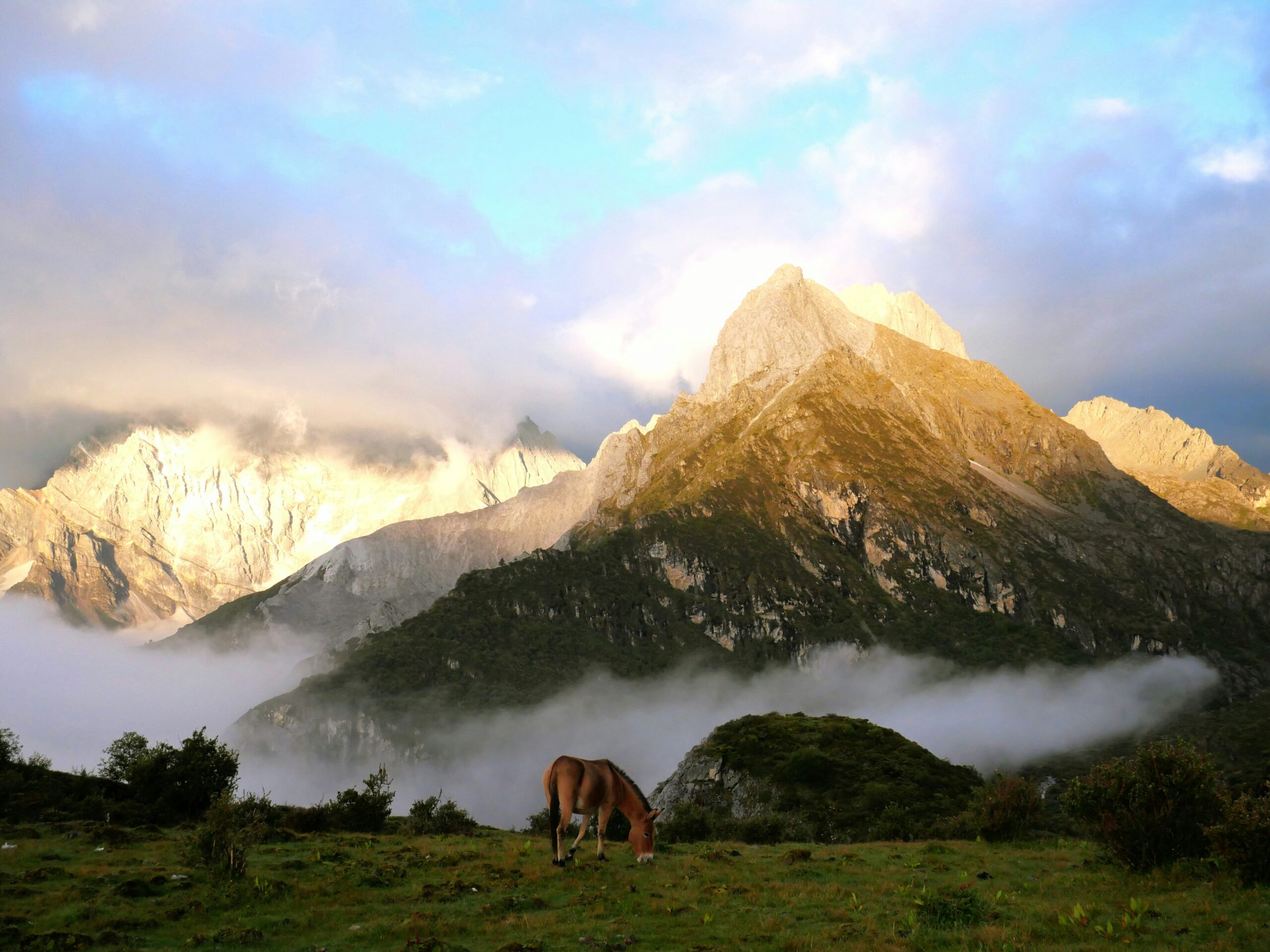
Back at Luorong Pasture, the setting sun had turned the meadow gold. Horses rested by the water in twos and threes, utterly at ease.
I tapped Peter on the shoulder. “There is a line in Li Qi’s ‘An Old War Song’: ‘At dusk they water their horses by the Border River.’ Isn’t this exactly the scene before us?”
Our friendship across the generations had begun with classical poetry. For years we had exchanged books, maintaining a gentlemanly friendship with an occasional flavor of old-fashioned literary pedantry. Seeing him and his wife smiling in Yading, I knew the hardships had not been wasted.
It was night on the road back to Daocheng, and the sky was full of stars. For more than an hour I leaned against the window and looked up, unwilling to turn away.
Kant wrote of two things that fill the mind with ever-new wonder: the moral law within and the starry heavens above. I was steeped in the clamor and grime of the world, long resident in a city dense with both. I could not decipher morality within its systems, or see the stars through its smog. Tonight was rare. I would simply look at the stars.
In my imagination, Daocheng had fields of wheat stretching to the horizon, the wind turning them into waves of gold.
Daocheng, forgive this narrow-minded dreamer. Your green poplars and white stupas, your red grasslands and Bowa Mountain—without the harvest I had imagined, you were abundant enough. Yading was an immortal realm; you were the mortal world at its most intoxicating. Without Daocheng, Yading would have been too celestial, too weightless, too far from the earth. Daocheng Yading: heaven and earth together, the last Shangri-La made whole.
I remembered the sickly self who had first reached Daocheng—gray-faced, dust-streaked, and wilted. More vividly, I remembered the self who returned: fully alive, clear-eyed, radiant. I was grateful for this initiation, for hardship and joy alike, each so rare and so worthwhile. I missed the sun in Daocheng most of all: clean and gentle, warming the body into a tingling languor.
Later we went on to Tagong, with its view of Yala Snow Mountain; the Greater and Lesser Songlinkou passes near Xinduqiao; and Danba’s Beauty Valley. The journey was never smooth. Though it was not the rainy season, rain fell all night in western Sichuan, and a rockslide blocked us at Xiaojin. We spent half a day at a farmhouse buying Sichuan peppercorns and picking apples, turning a landslide into a market day. On the way down Mengbi Mountain, Peter said, “Yun, when you get home, write Lost on Journey III. Too much has happened to us on this trip.”
He insisted the journey had broadened his horizons, but I still felt guilty. He and his wife were no longer young, and on their first trip with me I had brought them onto one of the most punishing roads in China.
Each of us is held hostage by life to some degree. Travel is one way I break free.
More than one friend has asked me which is more beautiful, Switzerland or Daocheng Yading. I cannot answer. The kind of love I have long believed in does not possess, compare, or keep the beloved captive. A love of landscape should be equally generous. However beautiful a place may be, we cannot own it or carry it away. I ask only that it remain where it is, for a thousand autumns and ten thousand years, its face unharmed. Switzerland is beautiful in its precision; Yading in its impermanence. I have stood on the Chapel Bridge, breathing the scent of flowers above Lake Lucerne, while the years seemed perfectly still. I have also dragged a body one breath from collapse to the highest point in Yading, my soul vastly free.
Quietly, I took leave of the last Shangri-La. I have never had much talent for sorrowful partings. If the meeting was joyful, let the farewell be smiling. Across ten thousand waters and a thousand mountains, to have met was already enough.
I see the green mountains—how lovely they are. Surely the mountains, seeing me, feel the same.
Postscript: Today, National Highway 318 through western Sichuan is smooth and easy, and the journey far more comfortable. Yet some of the old exhilaration has vanished—the exhilaration of being jolted and battered along the road, enduring every hardship, and then suddenly entering Peach Blossom Spring. Some experiences are irreplaceable precisely because convenience cannot bring us to them. They must be earned through an arduous journey.
_________________________

Cloud Wondering (Yun Li) is a Chinese writer whose work has appeared in Cha and the UK’s Outhouse. A regular contributor to Shanghai’s Xinmin Evening News, she attended the Banff Centre’s Literary Journalism residency in 2026. Her essays explore travel, memory, and personal freedom across languages, cultures, and shifting borders.
_________________________
Photo by Sebastian S on Unsplash
Find MeanPepperVine on Instagram @MeanPepperVine