| Amulya Gautam | October 2026 | Short Story |
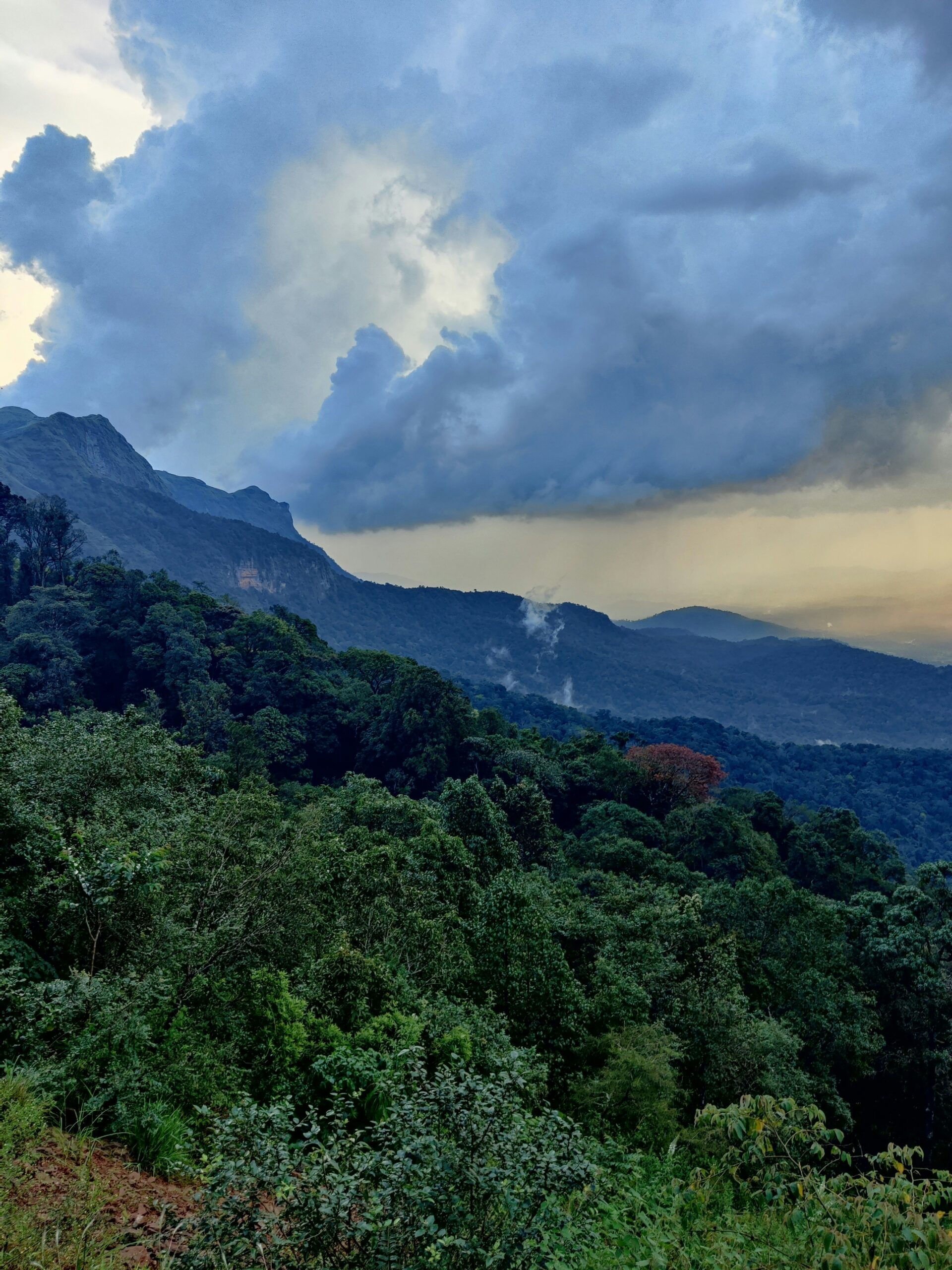
Iyal believed a photograph was a debt: you took something from the world, you owed it back honesty. She’d grown up in Nagercoil, daughter of a teacher and a radio-repairman, raised on her grandmother’s stories about a village erased from every map. That habit of distrusting clean stories had followed her through her diploma at the Government College of Fine Arts in Chennai, and later through two years assisting a wildlife photographer in the Nilgiris, learning patience and light. Wildlife work left her hollow, so she took a documentary fellowship in Pondicherry and started wandering into the forest township nearby, drawn less by its ideals than by the forest itself.
She was shooting sunlight through young tamarind when a voice above her said, “You will get your nice clothes dirty for a photograph of a tree.”
An old woman stood over her, leaning on a stick.
“Occupational hazard,” Iyal laughed, sitting up. “I’m documenting the restoration, how this all grew from nothing. Incredible, isn’t it?”
“It is an achievement, yes,” the woman said. “But nothing does not grow a forest. You grow it from something you decided did not matter.”
“I’m Meenakshi,” she added, lowering herself onto a fallen trunk. “This forest is planted over my great-grandmother’s grave. Over a shrine. Over a path the dead were carried on.”
Iyal’s instinct to verify warred with something older in her. “Can you show me?” she asked. “Not as a challenge. As a request.”
Meenakshi studied her. “Most people smile and walk away.”
“My grandmother’s village doesn’t exist on any map either,” Iyal said quietly. “I don’t want to photograph over someone’s grave and call it a miracle.”
Something in the old woman’s face loosened. “Bring your camera tomorrow. Six.”
Iyal arrived at six with two bottles of water and a new notebook. Meenakshi didn’t greet her, she just turned and walked, navigating not by path but by memory, pausing at bends that looked identical to Iyal’s eye before correcting course.
Eleven minutes in, she stopped beside a fig tree’s roots.
“Here. Move the leaves.”
Iyal knelt, brushing away mulch with bare hands. Beneath it, worn nearly smooth, was a carving, a trident, an old Tamil script she could only partly read.
“The boundary stone,” Meenakshi said. “No cutting wood within ten feet of the goddess’s ground. Someone forgot that rule, rather more than ten feet away.”
Iyal lifted her camera slowly, photographing the stone, the moss in its grooves, a small green frog sitting in the trident’s center as if placed there for the frame.
“I want to document all of them,” she said, not looking up. “Every shrine. Every path. With your words attached, not just coordinates.”
“You understand what this will cost you.”
“You already told me it wouldn’t be gratitude.”
Meenakshi almost smiled. “Then we continue tomorrow. There are eleven more I know of. Perhaps more I’ve forgotten, which is its own grief.”
Iyal lowered her camera. “Why trust me? You said most people just walk away.”
“Because you asked to be shown,” Meenakshi said, watching the still frog, “instead of asking to be told. One is collecting a story. The other is willing to carry it.”
By the time they reached the water tank clearing, the sun had climbed high enough to burn the mist off the canopy. Iyal could hear voices before she saw them, a group in loose linen, mats rolled under their arms, laughing about something as they filed out after their session.
Meenakshi stopped at the tree line and did not go closer.
“There,” she said, nodding toward a patch of raised, mossy ground near the clearing’s edge. “Under that stone bench they built for stretching. That is where the shrine to the forest goddess stood. There was a lamp lit there every Friday for as long as anyone in my family could remember.”
Iyal raised her camera, but a man near the group noticed her lens pointed their way and called out, not unkindly, “You photographing the yoga circle for your article? Best light’s actually an hour from now.”
“Just the clearing,” Iyal said, lowering the camera slightly. “It’s beautiful.”
He smiled, satisfied, and jogged off after the others.
Iyal waited until they’d gone before crouching by the bench, running her fingers along its underside. Nothing, no carving, no stone marker, just poured concrete over old earth.
“There’s nothing left to photograph here,” she said, frustration creeping into her voice. “No trace at all.”
“That is the point,” Meenakshi said quietly. “Some places I can show you a stone. Some places I can only show you an absence, and ask you to believe that the absence means something.”
Iyal sat back on her heels. “How do I put an absence in a photograph?”
“You photograph what stands on top of it,” Meenakshi said. “And you let the difference speak. A bench where a lamp once burned. That is not nothing. That is a story too, just one most people will not want told.”
Iyal was quiet for a long moment, turning the camera over in her hands. “The magazine wants a celebration piece. Fifty years of green. If I bring them this instead, they will call it something else.”
“They will call it something else. Not celebration.” Meenakshi’s eyes were steady on her. “They may call it betrayal.”
“Whose betrayal?”
“That,” Meenakshi said, “depends entirely on who you ask.”
They walked back in silence for a while, the forest thick and humming around them, birds startling up out of the underbrush at their footsteps. Iyal found herself photographing things she wouldn’t have noticed three days ago, a flattened rise in the earth that might have been a path once, a cluster of stones arranged with too much intention to be accidental.
“Meenakshi,” she said eventually, “have you ever told anyone here? Anyone from the community, the original founders, the trust?”
The old woman’s laugh was short and without much humour. “I told a young man from the trust office, many years ago, about the shrine near the well. He wrote it down very politely in a notebook much like yours. Nothing came of it. Perhaps it is still in a drawer somewhere, my grief filed under ‘community feedback.’”
“That won’t happen this time,” Iyal said, more firmly than she intended.
Meenakshi glanced sideways at her, something unreadable in her expression, not quite hope, not quite doubt, but the tired, guarded space between the two.
“You are very certain,” she said, “for someone who has not yet shown a single photograph to anyone who could take it from you.”
Ahead of them, through a gap in the trees, the community’s rooftops had come into view and with them, Iyal understood, the actual work was only beginning.
Meenakshi’s nephew found them on the path back. He was a wiry man in his forties named Selvam, arriving with the brisk, irritated energy of someone who’d been searching for a while.
“Athai,” he said, then stopped short at the sight of Iyal’s camera. His eyes narrowed. “Who is this?”
“A photographer,” Meenakshi said calmly. “She is documenting the old places.”
Selvam’s jaw tightened. “You brought a stranger to the shrine ground? Without asking anyone?”
“I am asking you now,” Meenakshi said, unbothered. “Consider yourself asked.”
“That’s not how this works, Athai, and you know it.” He turned to Iyal, his tone sharpening. “Do you understand what you’re doing? You come here for a magazine story, you take your photographs, and then what? You publish it, the trust reads it, the land office reads it, and suddenly there are surveyors on our doorstep asking why an old woman’s family graves are inside protected forest land. You think that helps us?”
Iyal felt her certainty from the walk back evaporate. “I thought recognition would help. If people knew what was here”
“Recognition,” Selvam said the word like it tasted bad. “You know what recognition brought my father, twenty years ago, when he tried to get the burial ground near the checkpoint registered? Months of paperwork, a court notice, and in the end nothing! Except now the Forest Department knew exactly where to put a fence. We lost access to land we’d walked freely for generations, because someone decided documenting it meant they could regulate it.” His voice had risen; a bird clattered out of the branches above them. “You people always think a camera is a gift. Sometimes it’s an invitation for someone else to take what little is left.”
“Selvam.” Meenakshi’s voice was quiet but carried an edge that made him stop. “She asked before she came. She listened before she photographed. That is more than the trust ever did in fifty years.”
“And what happens when her story runs, and residents start asking who’s threatening their forest? You think they’ll thank her for stirring up old graves? They’ll say she’s undermining the very thing everyone’s proud of.” He looked at Iyal directly now. “You’ll get your photo credit and go back to Chennai. We’ll still be here, living next to whatever mess you leave behind.”
Iyal didn’t answer immediately. She thought of her grandmother, of the notebook filed away in some trust office drawer years ago, of Meenakshi saying my grief filed under community feedback.
“I won’t publish anything without showing your family first,” she said finally. “Every photograph, every word from your aunt, you see it before anyone else does. If there’s a way to tell this story in a way that protects the land instead of exposing it, I want to find that way with you, not around you.”
Selvam studied her for a long moment, some of the heat going out of his posture, though not all of it. “Words are easy,” he said. “Let’s see if you mean them when an editor is asking you to cut a paragraph because it complicates the story he already sold.”
He turned to his aunt. “Be careful, Athai. Please.”
“I have been careful for sixty years,” Meenakshi said. “It has gained me very little except silence. Perhaps it is time to be something else.”
Selvam walked off without another word, and Iyal stood there, her earlier confidence replaced by something heavier, the understanding that she wasn’t just uncovering a story. She was walking into the middle of someone else’s fight over what safety even meant.
That evening, Iyal sat with Meenakshi on the veranda of her small house at the edge of the township, a kerosene lamp between them because the power had gone out again. Meenakshi seemed to want to talk now, unprompted, as if Selvam’s anger had cracked something open.
“You want to understand what this land was,” she said, “not just what it hid. Then you must understand what it was called, before it had an English name for a magazine to print.”
She said the old name, a name that meant, roughly, the grove where the goddess rests among the tamarind, and told Iyal how, before the 1900s, this had not been one village but three, strung along a dry riverbed that flooded only twice a decade, fierce and generous when it did. Fishermen from the coast married into farming families here. Potters worked one ridge, weavers another. It was never wealthy land, but it was never empty, soil worked in rotation, sacred groves left deliberately wild because cutting them was believed to anger the guardian spirits who kept the wells from running dry.
“Then came the drought years, and after the drought, men with money and better intentions than most, who bought the land for almost nothing because no one else wanted parched earth,” Meenakshi said. “The families who could leave, left. Mine could not, we had nowhere else, and no papers proving what we already knew in our bones. When the forest began to grow, it grew over the ones who stayed as much as the ones who left.”
Iyal was writing quickly now, but something in the name Meenakshi had spoken, the old one, the grove name, snagged at her like a splinter. She’d heard a version of it before. Not here. Somewhere else, decades removed, wrapped in a different accent.
“Say it again,” Iyal said. “The old name. Slowly.”
Meenakshi obliged, and Iyal felt the floor of the evening tilt slightly.
“My grandmother,” she said carefully, “used to talk about a place with almost that exact name. She said her family left it before she was born, that it had been sold, that there was a dispute, that no one in my family ever wanted to speak of it again because it ended badly.” Iyal’s throat had gone tight. “I always thought it was somewhere near Nagercoil. I never once thought…”
Meenakshi went very still, the lamp flickering between them, and studied Iyal’s face the way she might reread a line of old script to be certain of its meaning.
“What was your grandmother’s family name,” she asked quietly, “before she married?”
Iyal told her.
Meenakshi didn’t answer right away. She looked out at the dark trees instead, and when she finally spoke, her voice had lost its earlier steadiness.
“There was a family with that name,” she said, “on the potters’ ridge. They left the year of the second bad drought, walking south with almost nothing, and no one here ever heard from them again. I was a child. My mother spoke of them sometimes, said one of the daughters used to sing while she worked the wheel, loud enough you could hear her three houses away.”
The lamp hissed. Somewhere beyond the veranda, an owl called once and went quiet.
“You did not come here as a stranger, child,” Meenakshi said. “You came here as someone the forest has been waiting to finish forgetting.”
Iyal didn’t sleep that night. She sat on the thin mattress in her rented room, notebook open, staring at the name Meenakshi had spoken until the letters blurred. In the morning she was back on the veranda before the lamp had even been put away.
“Tell me what happened,” she said. “The dispute. You said it ended badly.”
Meenakshi poured two cups of black coffee from a dented pot before she answered, as though she needed her hands occupied to say it.
“The land was never really sold the way the papers claim,” she said. “There was a broker, a local man, not one of the founders, someone who worked between the villagers and the trust in those early years. He told families like yours that the trust would pay a fair price, that everyone was leaving anyway, that it was foolish to be the last ones holding onto dying soil. Some believed him. Your family sold their portion of the potters’ ridge for almost nothing, on the promise that the money would be doubled once the full parcel changed hands.”
“And it wasn’t.”
“The broker kept the difference. This was common enough that no one thought to call it a crime, just misfortune, just how things went for people without lawyers or connections.” Meenakshi’s mouth tightened. “But your grandmother’s family did something the others didn’t. They protested. Your great-grandfather went to the trust office directly, tried to show them the broker had lied, that the land was worth three times what they’d been paid. He was told the sale was final, notarized, and that nothing could be done.”
Iyal’s hands had gone cold around her cup. “What happened to him?”
“He argued too loudly, in the wrong office, in front of the wrong people,” Meenakshi said. “There was talk of a case being made against him, trespass, disturbance, I do not remember the exact words used, only that it frightened the family enough that they left within the month. South, your grandmother said. I did not know that meant Nagercoil, until last night.”
The pieces were assembling themselves in Iyal’s mind now, faster than she wanted them to. “The broker,” she said slowly. “Do you know his name?”
Meenakshi looked at her for a long moment, and something almost like reluctance crossed her face, the specific reluctance of someone about to hand over a stone she knew would be thrown.
“His name was Selvaraj,” she said. “Selvam’s grandfather.”
The coffee cup nearly slipped from Iyal’s hand.
“Selvam doesn’t know,” Meenakshi added quickly, watching her reaction. “Or if he knows, he has never once spoken it aloud to me. The family built its whole standing here on being the ones who ‘understood the trust,’ who helped smooth the early transitions. It made them useful. It made them trusted caretakers of the very forest that grew from what they profited by taking.”
Iyal sat back, the veranda suddenly feeling smaller than it had a minute ago. Selvam’s fury yesterday sat differently now, curdled with an irony he didn’t even know he was standing inside.
“So when he warned me about stirring up old graves,” Iyal said quietly, “he was protecting a wound he doesn’t know is his family’s fault.”
“Perhaps,” Meenakshi said. “Or perhaps some part of him has always known, the way a house knows where its own foundation is cracked, even without anyone saying the word aloud.” She set down her cup. “This is the thing about memory, child. It is never only about the land. It is about who profited from everyone else forgetting it. You wanted a story about shrines under tree roots. I am telling you the shrine was never the only thing buried here.”
Outside, the morning volunteers were already gathering near the water tank clearing, voices bright and easy, utterly unaware that the ground beneath their yoga mats held two families’ unfinished argument, and that the woman with the camera among the trees was no longer just documenting it. She was standing, unknowingly until last night, inside it.
Iyal walked out through the trees she’d first photographed as a miracle, and did not look back until the canopy had closed over the path behind her.
When she finally turned, the forest had already swallowed the trail whole, no sign of the boundary stone, no sign of Meenakshi’s house, nothing but green folding over green, the way it always had, patient and indifferent to who remembered what beneath it.
The photo essay ran six months later, not in the culture magazine that had commissioned her, they’d passed on it, calling it “beautiful but off-brief,” but in a smaller independent journal that gave her the full nine pages she’d asked for. It did not go viral. It did not change any land records. The restoration trust issued a polite statement acknowledging “the complex histories of the region” and continued its work exactly as before.
But it did other things, smaller and slower. A researcher from a university in Puducherry wrote to Iyal asking for Meenakshi’s contact, wanting to record her oral history properly before it was too late. A young couple who ran one of the community’s guesthouses read the piece and quietly stopped hosting yoga sessions at the water tank clearing, moving the mats fifty meters west without ever publicly explaining why. Selvam began, awkwardly at first, then less so, walking visitors through the forest himself on weekends, not as a caretaker of green triumph, but as someone willing to say, here is what this ground remembers, and here is what my own family did to make people forget it.
Iyal kept the stone Meenakshi had given her on her desk in Chennai, where it sat beside her laptop through every assignment that followed, puff pieces on heritage architecture, a difficult story about a fishing village losing its coastline to a port expansion, a wedding shoot she took only because rent was due. Whenever a story tempted her toward the clean version, the one with no splinters in it, she’d turn the stone over in her palm and remember the trident worn smooth under forty years of leaf litter, and the frog that had sat in its center as if placed there for the frame.
She went back twice in the following two years. The second time, Meenakshi’s house was empty, not abandoned, Selvam told her, just quiet, because Meenakshi had died in her sleep that spring, peacefully, in the season when the tamarind flowers. They buried her, at her own long-standing insistence, beneath the neem trees in Zone Four, within the ten feet the old boundary stone had always protected, whether anyone above ground remembered why or not.
Iyal photographed the grave only once, briefly, at dawn, and did not publish that image anywhere. Some things, she had learned, were owed silence rather than exposure; the difference no longer seems confusing to her the way it once had been.
She still believed a photograph was a debt. But she understood now that the debt wasn’t always paid by publishing the picture. Sometimes it was paid by simply staying long enough to be trusted with it, and knowing, finally, when to put the camera down.
_________________________

Amulya Gautam is a journalism scholar from India with a keen interest in literary fiction and storytelling. Curious by nature, they enjoy wandering through unfamiliar streets, engaging in conversations, and reflecting on the social issues that define communities across the world. Their writing is driven by a fascination with human experiences, weaving together observation, emotion, and narrative to tell stories that resonate beyond the page.
_________________________
Find MeanPepperVine on Instagram @MeanPepperVine