| Jashan | October 2026 | Non Fiction |
Where did life begin? Not the stromatolites. Let me rephrase my question. Where does our individual life, in the ordinariness of its existence, exactly begin? One tends to think of the day of birth, when a clueless little face can inspire fantastic aspirations. “Ye shall bring loads of happiness to your family.” “Ye shall honour our little legacies.” “Ye shall pray to such and such God.” Try crying in response, and that will only be taken as life-affirming! One stifling summer night my father had told me the story of my own birth, “That mother of yours cried so much after seeing you, you know. She refused to hold you. The nurses kept asking for clothes, and she couldn’t even remember what bag she had put the baby’s clothes in.”
“Why didn’t she want to hold me?”
“The child before you was a boy. He passed away soon. And then you took his place.”
The farthest my memory takes me these days is to the boy with candies. Hair braided and rolled into a bun at the front of his head, like all Sikh boys. He was older than me by a few years, and I don’t remember his name or his face. But I can visualize him walking into our house at the rusty gates and smell his entry for him- a heady cocktail of hay and cow-dung. I can remember him swinging the laundry paddle repurposed as a cricket bat, and I can remember him opening his palm full of candies in loud, shiny wrappers and offering them to me. The candy business couldn’t have gone on for more than two weeks before it ended abruptly, over hide and seek. Hide and seek was my favourite game, but it was already becoming too “girly” for my brother, who was the only playmate I was generally allowed. Mr.Candyboy decided to be the very picture of chivalry one day and chose to take my side in the grand battle of our evening games, offering to hide first along with me and letting my brother seek. We were hiding in the trough, lying on our stomachs, heads touching, a straight line of two giggly bodies. Suddenly, I found myself hanging in the air, a tight grip on my elbow the only claim against gravity. I was deposited at my mother’s feet while she was setting up a fire in the chulha. I watched her face burn as she learnt that I had been “discovered” with a boy, words scrambling and falling over each other on my father’s tongue,eager to be let out. My brother was called to the council and appointed as the fall-guy. He was instructed to stop playing with that boy immediately. My mother looked at me, my head was bent, and I was ready to get thrown in with the maimed beggars outside Golden Temple. I understoodthat I belonged with those people, she couldn’t keep me at home anymore. I heard words that sounded so simple it didn’t even feel like punishment- I was to hide in the kitchen anytime Mr.Candyboy showed up.
My mother didn’t laugh or wear lipstick like other women. There was our school fees to be arranged, groceries for the house and fertilizers for the fields. Even when she was sitting still, she would be counting on her fingertips. I wanted to rest my palm on her forehead, run my fingers through her hair and see if she would smile. But neither my mouth nor my fingers had a language that could make me my mother’s friend. It was uncomfortable to watch her squirm anytime a woman from the neighbourhood came to see her, and my father inadvertently found a way to insert himself into the conversation. The bravery he held in commenting on the loss or gain in the women’s weight, their daughters all grown up, was a glory beyond description. The neighbour would leave, and my mother would burst- into tears sometimes but mostly into shouts, her voice breaking in between, strengthening and rising again, like opera. Her mouth produced words beyond my comprehension, about honour and shame, about the daughter no one would marry if he didn’t change his ways. He listened, without ever uttering a word of apology or explanation. She would stop eating and spend her nights walking around in our dark courtyard while he slept an angel’s sleep. Meanwhile, the cleanliness of our school uniforms and the fullness of our school tiffins never suffered. School was an escape to normalcy. It was comfortable and formulaic. If the report cards had a lot of “As”, the teachers would get up from their chairs and greet my mother at the parent-teacher meetings. She would return home with a lightness in her step and dust off the Gutka Sahibs. School, coincidently, also brought me Elizabeth Bennet. I like to think that I would have been a better daughter to my mother if I hadn’t run into Elizabeth Bennet. In the tangible world, my mother and I collaborated to put my silence on display, a necessary win against all fatherly failures. But on some unremarkable day, Elizabeth quietly entered the hollows behind my eyes. I let her laugh at the absurdities she saw in my world. Her opinions became my secret, guilty pleasure. It was Elizabeth Bennet who took me on long walks away from home when things got too loud. I watched as she freely let her hem get “six inches deep in mud”. She had me stand at the edge of my father’s fields and showed me, for the first time, that the house looked very small and distant from there. No sound from the house reached us where we stood. The only movement was a quiet wind, coming all the way from rural England, open to questioning and free interpretation.
I must have been around 14 or 15 when one day, at school, I got sick with a mild fever. A phone call was made for my parents to come get me. Half an hour later, out of the sick-room window, I watched my mother park her scooter and almost forget to put it up on the side stand. “Is it…?”She asked the sick-room attendant before looking at me, panting and sweaty. “No, no. It’s just afever.” She sat down on the little bench by my side, wiping sweat off her thin face with her dupatta. When the need did arise, she filled my life with assorted packets of menstrual pads. She had come from a motherless home, protection was her weapon of love. Although, I did take a hesitant pleasure in watching her be like that. It was only when she was being fiercely overprotective that she seemed most alive to me, normal and human. So I let her hold my hand when crossing all roads, even when it embarrassed me. Before I had any awareness of the grand Indian penis game, my mother was there, wedging herself between me and the man behind me at the bus-stop, the ATM, the Gurdwara. She scared off the pesky little romeos outside tuition classes before I could question them on their mating rituals. She paid my school-van driver a little bit extra, as a bribe, to not play any music if there were any boys aboard. There was a brick kiln close to our house. I befriended some of the labourers’ daughters. They addressed me as “didi” even though they were much older than me, and they liked to look at my books. They had boisterous ways, and in their company, I could feel ancient glaciers melting from under my skin. My mother waylaid them one day and told them to never come back. Tantrums remained ineffective. “Have you seen the way he looks at them?” she asked, and the conversation was over. Yet, with all her barricades protecting the women of the world from her husband, and her daughter from the world, she suffered from blind spots. We were at a langar organized by the village at the beginning of every month, when a classmate of mine, popular for her coquettish ways, told me that her “boyfriend” had secretly gifted her a phone. “And look what he sent me!
Hee Hee Hee!”
My father’s sisters and their sons bribed some government agents and laid claim to a share in my father’s land. As my mother sat down with lawyers and counted their bribes, she had her son- too little, and her husband- present in proxy only, by her side. This time the big woman was joined by a small man, both counting on their fingertips. Her husband, this time in revenge, sought women outside. But she was stronger by then, and she finally had an associate. My brother went with her, wherever she needed to go. He coaxed, threatened, shouted at his father in his little man voice. I cooked. I cleaned. I stayed at home. I read. When there wasn’t money to buy new books, I took down old newspapers from the shelves and read them. I spent my Sundays at Gurudwaras, because that was the only place I could be freely purposeless. The shape-shifting phantoms that lived in the moon, were my only friends. They let me sit in the shadows, late at night, and look at their magnificence. I waited for things to change. I didn’t even know what this change would look like. I confess that I daydreamed of knights and white horses. Once, I was struggling with my scooter in the college parking lot. An old man, probably on his evening walk, approached me.
He had a kind voice. He helped me with my scooter, and I cried big, ugly, unreasonable tears in front of him. He lay his hand softly on my head and walked on. A few more years passed, and the matchmaker aunties and uncles cried “marriage”, “marriage”, “marriage.” I was practically fatherless, they said, and everyone was watching. My mother almost gave in. When arguments failed, I cried. I cried for days on end. I sketched ridiculous plans of running away from home. I gave her naive little threats. I broke her heart with the words I said, but she showed me kindness, and I will forever be grateful. One night when I was 23, she stood by me at the airport and let go of my trembling hand from her trembling hands. And my stromatolites have been exploring happiness at this stage in their evolution.
_________________________

Jashan is an eager reader and a reluctant writer, drawn to literature that sits at the crossroads of gender, memory, and everyday interior life. Her work is shaped by close reading and a persistent interest in how private emotions are produced by public structures. She is especially attentive to marginal voices and the quiet violences embedded in everyday language. Beyond reading or writing, she can often be caught taking long walks by herself, caressing leaves and looking day-dreamy.
_________________________
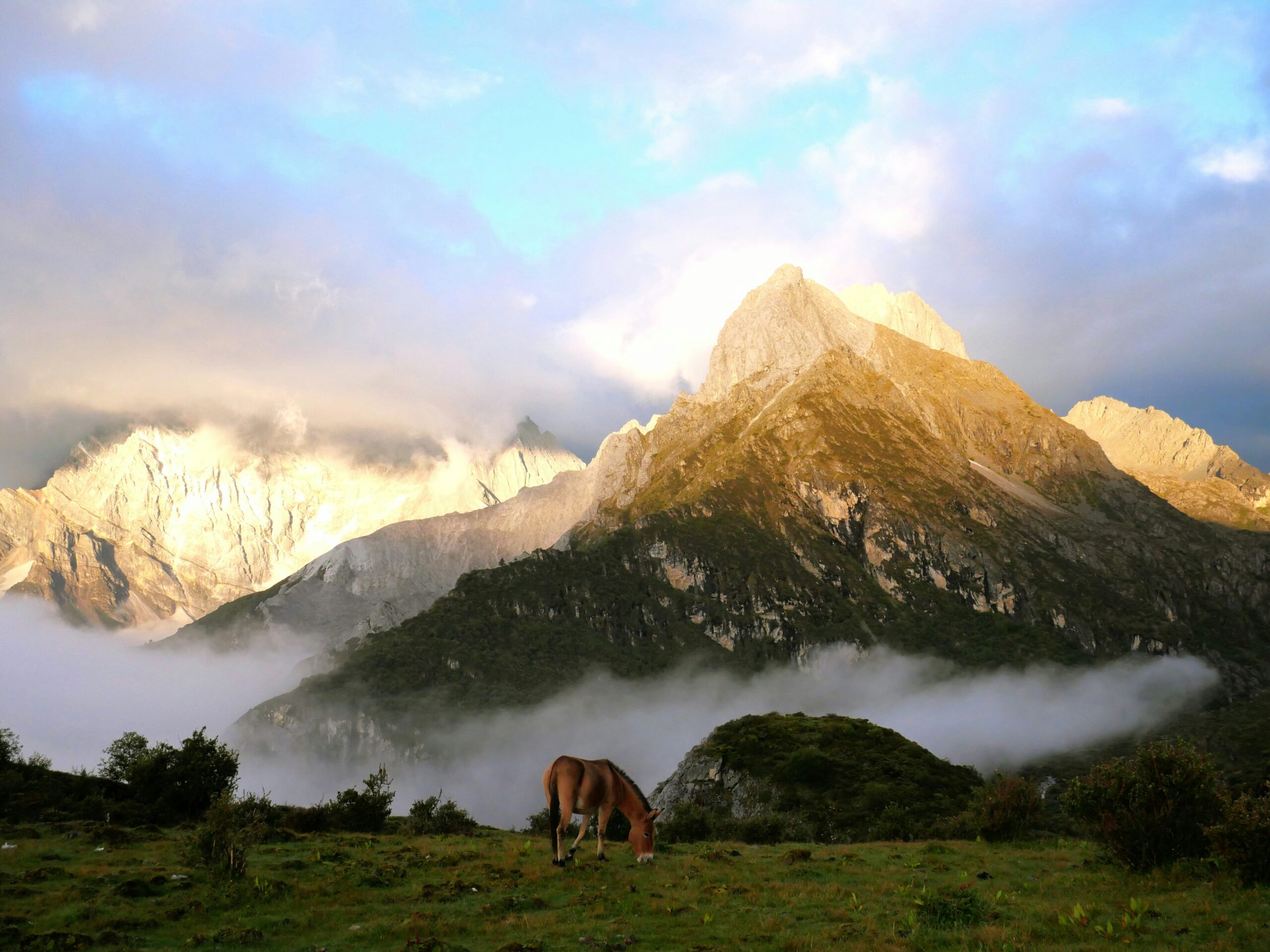
Photo by Surinder Singh on Unsplash
Find MeanPepperVine on Instagram @MeanPepperVine