| Oindrila Ghosal | July 2026 | Short Story |
I
The crumpled, final breaths throbbed in the pigeon’s neck. Three crows perched on the overhead wires , stared down without flinching. The sun-warmed emerald of the pigeon’s neck shimmered in their glossy black eyes. Their claws, curled around the black insulation of the wires, remained poised. The skeletons of the erstwhile telegraph lines hung silent. On the cobbled street, strewn with wheat grains, the pigeon gazed through the haze of ebbing life at the unending, bright blue sky. Shrouded people, keeping their distance from the dying bird, flocked around—crushing the grains beneath their feet, bearing salvers of flowers or sequinned veil. The crows, in no hurry to rehearse the eulogy, waited.
The Portrait of English Rose
Her eyes burned from holding them open with her parted fingers for far too long. “If I start crying, we’ll have to do it all over again,” she sniffed.
Tossing his opinion into the tempest of his head, he reclined his neck from peering and rushed to his easel. On the unwashed wooden palette, he squeezed out acrylic grey, yellow and brown, whisking the proportions with the roughened bristles of his brush.
“You haven’t said anything yet.”
He only groaned, not looking up from his frantic blending.
“I asked if you’re done.”
“What?”
“Looking into my eyes.”
He craned his neck to steal one glance at the shade of her iris, and another at the coloured bristles. Then, leaning in, he etched a stroke at the bottom of the starched canvas. The meandering line, still glistening, was immediately doused with the lash of his warm breath.
He moistened his lower lip and took another look. Though dryness had begun to settle in, his combination sneaked within the same spectrum of what he had observed. He pushed his head back and unfurrowed his brows. Now that the contentious step was settled, he revisited the questions he had chosen not to answer.
“Surely you may,” he said, facing her—the mist of unwavering permutations lifting from his eyes.
Smiling, she slouched her back against the unplastered bricks of the wall. “I was used to sitting this way,” she said, fiddling through her salwar for her box of matchsticks and beedi packet. “When I used to model at your university. That was before I ripened. Your seniors knew me well. What year are you in?”
“Third.”
“Ah, that explains why you’re so specific about the details.”
“Your eyes,” he confessed, scrabbling at his forehead, “are a peculiar shade of grey. It took me nearly the whole day to get the shade right.”
“Might be. I wasn’t known in the circle for getting my face painted.”
He looked away from her askew smile. She, disregarding the threads of bashfulness he had so terribly woven himself into, lit the beedi between her lips and continued, “It’s not your fault. I know nothing about art. Maybe you’re right—eyes like mine take a lot of time to be painted. What I know is that these eyes prompted my mother and her friends to name me Angrezi Gulab – English Rose.”
The crude white smoke, evanescing from either side of her lips, slid into the labyrinth of dense curls on her head, never to be found again.
“So, your mother also had the same eyes?” He licked his lips.
She nodded. “Just like her mother.”
He, behind the garb of pretending to understand, stacked up a little courage. “And your father?”
Her maniacal laughter whirred alongside the squeaking fan blades hanging from the asbestos ceiling. “You don’t ask that question here. Not even to Budhia’s kid at the crossroads.”
Her laughter only pushed him deeper into his cocoon and she, sensing the signs, tamed her peal in time. “Now that I’ve told you the rule, tell me what you want. Tea?”
“Water,” he blurted out.
“Hot or cold?”
“For washing my brushes,” he added at once.
II
The notes of Asr gently tucked a soft blanket beneath the arrhythmic body of the pigeon. Its eyes were fixed on the sky. The sky had never been bluer. Melted blue poured into its unblinking eyes and swirled out through the pupils. Perhaps the churning sky fuelled it to burn whatever feeble remained trapped in its muscles, enough to spread a wing over the walked-on and spat-on grit. The crows, holding their breaths in their beaks, did not move.
Adam’s Ale
“Pankhudi,” she bellowed.
She did not roll her eyes away from the unstirred curtain in front. When not even a scuffle scratched at the little hairs in her ears, she lowered her voice, “Had you seen her when you came in?”
His confused head jerked from side to side.
“She must be down the street with her friends, making videos then,” she scoffed. “I should not have bought her the phone in the first place. What good do phones do to these kids anyway? All they do the entire day is contort their faces and shoot themselves dancing beside the drain. You tell me. Do you think your phone…” Her neck, sweeping around the cuboid room, locked onto the ring light and the phone. “You will edit this out, won’t you?” she squeaked.
“It is not recording our voices.”
Her flared nose let out an uneasy breath, unsure of what he meant.
“I will dub in the techniques of portraiture later,” he confirmed.
She drifted her eyes to the light. The stark white glow exchanged glances with her, caging her in pixels. The transparent, seamless walls kept the artist’s jargons from slipping in. Even the bulb on the wall was unspared. Its filament had never burnt bright. And now in its senescence, basked in the umbrage of white light.
Trapped within, time trudged; she and time did not share the same space. If the artist at the margin was maintaining an account, she could not tell. The cage shattered to pieces eventually when Pankhudi asked, “Where should I keep the glass?”
She lifted her eyes from the scattered shards and gaped at the wiped stain on her lips. She wanted to caution her against standing on those sharp pieces but realised it was already late. Her eyes had not hidden from her the blood trickling out of her tender feet. If only she had warned her to stay away and bring the water a little later, once she was done sweeping. Now she couldn’t look away. Yet she pulled her eyes to the smudged red painted on her nails, curled around her brother’s glass—their only steel glass.
“Make it quick.”
“But where should I keep it?”
“Here. By the easel, the artist helped.
She quickly set the glass down and rushed to the phone mounted on the ring light. She had just turned to her mother, smiling through the gap in her teeth, when her mother snapped, long before a word could tremble on her lips, “Did I not ask you to leave at once?”
Pankhudi’s stunned grey eyes scanned the tremor around her mother’s mouth. But Angrezi Gulab, fuming, went on, “When you can’t see the blood and the shards around, then at least listen to me.”
Her eyes were glued to the capillaries quivering in her mother’s stare. She and the branching rosiness on the white curves were reading from the same page, flinging the same questions at each other. And yet neither could reason the dread. There were no shards piercing her feet. In fact, the floor was clean, mopped hours ago. But if she spilled the beans now, it was likely that her mother would pronounce her to sweep and mop again. She gulped. This conjuration was unlike her mother, who never told her fairy tales at bedtime. What if she was possessed? The old woman living in a shanty beside the drain had been exorcised only last week. Maybe the same spirit had found a home.
Her speculations were cut short by the ring of her phone in her pocket. Without even sliding it out from her skin-hugging denims, she knew it was her friends from beside the drain, who had lost patience after she had promised a short break from video making. Swiftly, she, untying the laces of explanations, sprinted out of the door she had not walked in from, straight onto the scorching streets.
Angrezi Gulab sniffed in the last puff of smoke and slipped her long nail between the cap and the stem of the nearest bedpost. The cap unlatched without effort. She flicked the charred bud inside and closed her eyes, stretching her legs out front.
The artist, the lone witness to the curtain taking Pankhudi’s shape, and to her walking out with the glass of water from behind the unfurling curtain, huddled, as if guarding his own secret—hesitated to break the inertia. His arms and legs did not untangle from the knot he had forced them into. Just like his limbs, he had restrained his mouth from asking her when she had come in. Along with his sealed mouth, his eyes had not risen to her swaying, sinewy arms and legs and the many sequins on her shirt and shoes that had dazzlingly filled the room.
He glanced at his wrist watch through the corner of his eye… There was still some time for him to start with the outline of the subject. He peered intently at her from where he was sitting to confirm if she was awake. When he failed to figure it out, he cleared his throat at last. “Which class is she in?”
She did not bother opening her eyes. “Class,” she scoffed.
“Is she not enrolled?”
“I, like all mothers, enrolled her in school. I hoped that she would narrate me stories from books or bury her neck in calculations. Do you know what she was taught instead? How much acid, mixed with toilet cleaner sparkles the commode best. A simple sum, eh?”
His slackened tongue coiled in his mouth, holding back any wayward word.
“It had begun with her name. When she said Pankhudi, they asked for her surname. She lied to them for a few days, tagging on a pricey surname she had heard at a movie. But that did not last long. When she was asked to submit the birth certificate and she did, they sniggered at her fallen mask and her missing father, banishing her to the unflushed, stinking washrooms.”
She opened her eyes. “Then, one day she came home and never returned. I should have known. She is my petal after all, Angrezi Gulab ki Pankhudi.”
She replaced the cap of the wrought iron bedpost and reached for another beedi. Cupping the flame, she lit the rolled end. A few shorter puffs later, she let out a dense smoke that slithered in her tangled hair.
“So, a few weeks ago, a photographer from a magazine had come to our door. He clicked a few pictures of us and our home and left a small token of money. Seeing the amount, she began coaxing me to buy her a phone, day in, day out. All her friends have one. They are the ones who have taught her to wear lipstick and shake her waist to songs they incessantly play till the lyrics and the melody unwind. She kept whining that the grandson of the woman who was recently possessed had earned enough from making videos to buy a phone with a bigger camera. They kiss the ground he walks on, you see. And in the end, I gave in. Unless you have a heart of stone, you can’t leave your kid’s pleas unheard.”
“Do you believe in ghosts?”
Her lips curved in a smile. She closed her eyes again. The smoke, in its own accord, vanished in her tresses.
III
“Sapan sees a pigeon,” Budhia’s thirteen-year-old son, from across the dying bird, clapped his unclubbed hands gleefully, “Sapan wants the pigeon.”
Alarmed, Budhia limped to her shrieking son and wrapped him in the grubby shawl hanging from her shoulders. The boy still wouldn’t stop clapping. She grabbed him closer to her swollen belly, and in desperation, hushed him at a pitch higher than his cries. He, nonetheless, relentlessly thumped the stretched skin of her belly. She did not loosen her grip. Through the unruly jungle of matted hair vining to the centre of her bronze face, her eyes were vigilant for the fleet of cars and the stones clenched in the fists of those returning from the places of worship.
Caliginous
She asked instead, “Do you believe in dreams?”
“Who doesn’t?”
“Not if you want to be one of the caged mynas,” she laughed. “I mean the dreams you see in your sleep.”
“I don’t think I do.”
“Neither do I.”
“But do you believe in ghosts?”
“Do you care for a story?”
Reluctance choked his throat.
“Once upon a time, the dust and the sewage birthed a woman. And then a lot of women. A populace of women. Their lives were no different from that of their creators. Walked on. Spat on. Dumped out. In the end, all of them died from causes natural and otherwise. One by one. P.S. Those who die here, never return.”
“But what about the possessed woman?”
“I don’t know. Newfound money, maybe.”
He wanted to emphasise that the ruckus she created over nothing on the floor and then forgotten completely was no less than horror, but chose to lend an ear to her rambling.
“Do you know where the real horror is?”
She lifted her kameez to bare the protruding veins running haywire beneath the skin stretched thin. Stroking her rounded belly, she said, “Here. In life. Have you touched life before? Come, feel my belly. You are an artist, aren’t you?”
Unprepared, he picked up the brush, only to drop it in the glass. The dried paint, moistened, diffused into the water. The discordant colours spread out across the expanse, picking the shades of the glass. She unleashed her laughter at his clumsiness.
“Can,” he stammered, “Can we please sketch the outline first?”
She instantly pursed her lips, composure settling over her like clay.
IV
And yet the pelted stone did not miss Budhia’s hunched back. The stone had as if not struck Budhia, but cracked open a bottle of trapped laughter, forgotten in the seas ages ago.
“Who is the father this time, Budhia?” jeered one.
“No one has the answer to that here,” mocked another.
“What about your son’s age, then?” darted yet another.
The crows above only prayed to leave the pigeon unscathed.
The Caged Mynas
Rolling their trousers above their knees, Agastya, holding his sister’s hand, entered the car. Their mother, seated in front, stopped fanning and covered her nose with the end of her saree. “Once the mess is cleared, we shall immediately take the car for cleaning,” her muffled voice floated in the car.
The siblings looked at each other and shared a small smile. But knowing fully well that their mother’s eyes trailed along their reflections in the mirror, they quickly wore their masks. “I can’t believe we are finally going to see the caged mynas,” Agastya exclaimed, swinging his feet under the seat.
“And if you keep spreading dirt all around, I’ll drop you right here,” their mother rebuked.
His sister burst into unchecked laughter. To that, their mother warned, “And if both of you haven’t memorised the preamble, forget everything about seeing the caged mynas.”
Jumping the gun, he wasted no time in reciting the first few lines. His sister joined in from the fourth. The two repeated the preamble so many times in unison, it was as if they were caught in a playful loop.
At one point, his sister dropped out from fatigue and yelled, “Why is daddy taking so long?”
Their mother, grimacing, counted the bangles stacked on her plump wrists and sighed. The children, unable to pick their brains on what stirred in their mother to resort to counting the gems on her bangles, resumed singing the preamble aloud.
Through their loud sing-song rendition of the Constitution’s preface, and their mother’s unabated counting, their father, the minister of the province, unlocked the door and sat at the wheel. He pushed the key in and pulled the gear. The brother and sister, abandoning their chant, cried out in elation.
He stole one cursory glance at their bobbing heads in the mirror and turned the wheel. The threaded wheels waded through the sewer waters that had gushed into their fenced and guarded lands unannounced, when the moon had still not touched the horizon. Their communion with the hands switching machinery keys, and those raging on keyboards chronicling the mishap, had gone down the drains. And in that vexation, he had agreed to drive his children and wife to the bureaucratic promenade, where that evening the caged mynas were to be put on display.
“To the caged mynas we go,” he cheered.
She, beside him, did not turn her rotund face from her tended beds of roses, sticking their heads above the inundation. Could they smell the stench? If they could, were the unfurled petals diffusing distress calls? Were they clinging to hope? Or, like her, were they, neck-deep in floodwaters, still blooming one bud after another?
These questions, like the broken sewers, had no black box. But at least they, unlike the rotting waters submerging their state-of-art metalled roads and bungalows, were emollient to the itch in her throat. Within the inflamed lumen, the briskly radiating petals of the blossom—blooming on a winding stalk, rising from the macerated seed rooted deep in her entrails—swayed to the musk on his clean-shaven jaw, which the woven lattice of her saree could not bar. But the shoot was not a weed. Of the many chewed and gulped ambushed receipts of jewellery pieces never found in the house or vaults, after meals, only one so far had thrived on the acidic and bilic confluence, fertile with the reek he brought home after nightly escapades. She pressed the saree tighter against her nose.
Unbeknownst to her itch, he, focussing on the wipers sweeping out the occasional splashes of sewer water, chronicled the fables of the caged mynas. He suggested they stuff cotton in their ears if the mynas started dispelling their eloquent dreams of freedom or, shut their eyes in case they staged readings from their charters on waging wars for liberty. It was advisable, he said, to see them from a distance, without getting too close. The children, at each syllable, nodded their heads.
Unable to control her curiosity, his daughter interrupted in the middle of his reeling through the dos and don’ts list, “Have the caged mynas also rote-learned the preamble?”
The minister did not reply, drawing an end to his discourse. The children sank in their seats and, once again, revised the preamble in their heads. The car slushed through the murky waters, down the citadel. Downward, the waters were low. By the time they paced across the hamlets of perfumers and their fields of flowers, the nasty sprouting from underground had receded. The wheels rolled smooth.
Inside, in the feeble light of the street lamps, their son divided his glance between the sea of fluttering petals in the breeze and at their stoic parents in the front seats. Some time into his back-and-forth, his mother’s purple face behind the saree in the mirror grabbed his neck still. Clasping at her seat, he gasped, “Can we roll the windows now?”
She muffled a harsh denial.
Their father only sighed and turned on the yellow and red lights at the ends of the car. He shifted the gears and streamed uninterrupted down the roads, down the crossroads. At the crossroads, the meandering wheels ran over something light and, simultaneously, a woman scurried to the pavement, gripping a boy’s wrist. The jerk was nothing dramatic, unlike the fleeing of the woman. The children whispered to each other what might have been under the wheel and agreed their parents were too occupied to feel a thing.
He finally lulled the engine at the head of the rickety bridge flung across the spurting pungency of jet black, and alighted, scrambling a makeshift excuse of thanking the members of his constituency for tackling the sewer leakage well.
V
Budhia was still wheedling her son to step aside when the speeding car caught her loosened shawl beneath its wheel, disrobing her. Without thinking, she pulled her son across the road and heaved. Shuffling in her naked embrace, he gaped at the car driving over the spread-out wing of the bird.
Bride
The rear lights of the minister’s car veiled Shevanti’s sandalwood-stippled countenance in scarlet. She tightened her grip on the grill rods. Holding them, she twirled a little. The precious silk and gold he had gifted her wailed shehnais on her skin. Only the filigreed metal dazzled. None of the occupants in the car, and not even the minister, rushing out, turned around. The tears slipping down calmed her blush.
If only she had kept from him the possession next door and allowed him nightly visits.
Every night since then, she had decked herself as a bride, longing for his savouring mouth on her perfumed contours. But his car had not stopped at her weathered door. The desolation had not invited the homeless ghost either.
She hummed a wedding song; its tune now etched into her scarlet breath.
VI
A devotee, homeward from the temple, carefully placed a tumbler of water and a few marigolds by the quivering beak of the pigeon. With folded hands, he whispered a prayer under his breath and went on his way. Budhia, crouching with her son in the distance, tugged their hands and legs into her belly.
Clandestine
“Leave,” Angrezi Gulab’s brother panted at the threshold.
She and her daughter looked up from the phone. “Where?” she countered his trepidation.
He first filled his lungs with the heated-asbestos air of his home and then reasoned, “I saw him crossing the drain. He is coming this way.”
“Didn’t you tell him this isn’t the right time?”
“I don’t think he saw me. Now will you stop engaging me in your silly banter and hide somewhere with your daughter?”
He could no longer stand at the threshold. His febrile tawny frame, greasy with the slippery opacity from walking into the abyss of the sewers to fix the leak, ached. He wiped his feet and tottered in with the languished stench—inching to his glass—where the easel had once stood, and lifted it. In no time, he chugged the murky water, forgotten to be discarded.
VII
The inconspicuous crows beneath the stars deemed it was now only a matter of time. They briefly flapped their wings in preparation. Inside their beaks, they began the countdown.
Inheritance
Behind the tall grasses, she squatted with her daughter on her lap. Their aching lungs eased. Angrezi Gulab breathed. Pankhudi breathed. These unheeded grasses, at the far end of the slum where the kites sometimes nested to lay their lays, rustled. The warm air cascaded. It criss-crossed across the fragrant dewy blades. The songs of the untrampled echoed. Sleep, drenched, slid in the burrows with the sewer rats. The stars, light years away, flickered.
She pushed her back against her mother’s lap. “Will you tell me a story?”
“Which one? Hmmm…how about our story?”
“I don’t think I have heard that before.”
“I haven’t told you this one before. This is the story of a young woman who was born with the smell of fish. Once upon a time she came across a saint who, smitten, proposed to her: If she bore his child, he would take away the nasty smell…”
VIII
The crows were flying in circles. Below, the pigeon’s neck had ceased throbbing some time ago. At the end of their measured revolutions, they turned their beaks toward the centre of the circle and, one by one, descended to the pigeon’s fiery eyes.
END
_________________________
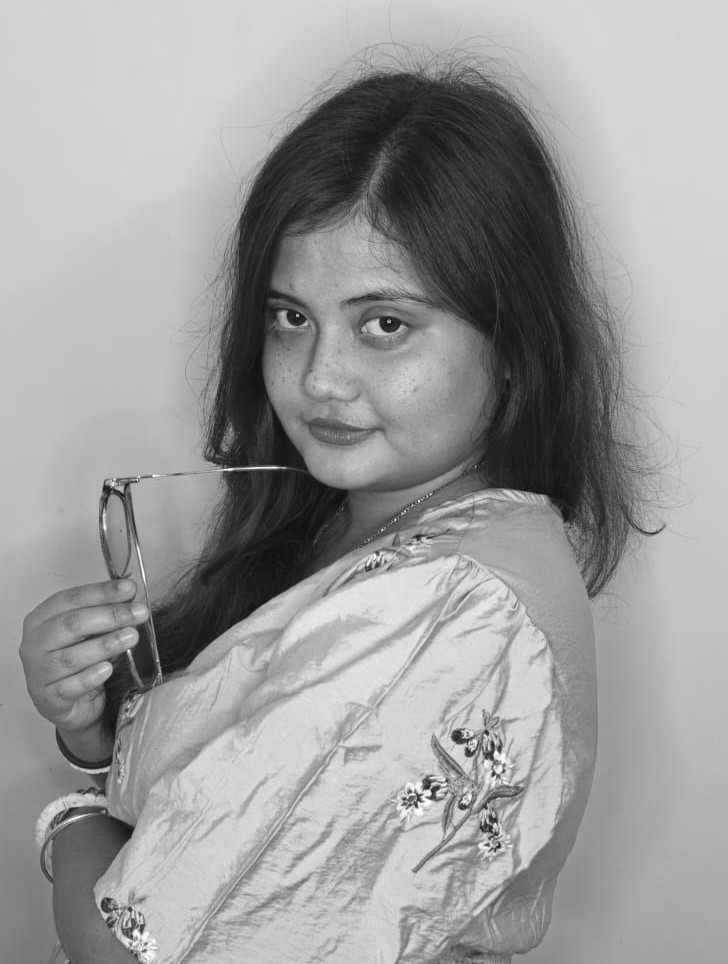
Oindrila is an emerging author and also a doctoral student at Tata Memorial Centre – Advanced Centre for Treatment, Research and Education in Cancer, Navi Mumbai. Her publications include The Harlot’s Veena, The Asylum, The Jungle Within Me, Vestige (Kitaab International); To The One Called Home, Of Dreams and Dust (Academy of the Heart and Mind); The Tussar Saree (t’ART Press, EgoPHobia); The Perfumers (Tint Journal); Homecoming (Borderless Literary Journal) and Ecotone (Freedom Fiction Journal).
_________________________
Find MeanPepperVine on Instagram @MeanPepperVine