| Java Ravi | July 2026 | Short Story |
The Principal, Urvashi Vasisht, had put on her stern look; hair pulled tightly into a bun, not braided into a loose plait, and forehead dotted with a tiny black bindi instead of the usual large scarlet one. The hunched figure in the corridor watched her march into her office. The teachers huddled in the secretary’s annexe shuffled out to follow her.
Behind them, Tuhina dragged her feet into the room and stood before the disciplinary committee, ready for the accusation.
Mrs Vasisht pointed to the package on the table: a bundle of moist brown sticks, each the length of a crochet needle, sticking in places to the butter paper wrapped around them, additionally secured with a jute string.
‘This is a crime. You are not here for misbehaviour. Charas was found in your trunk. You have committed a crime. The Juvenile Justice Board may decide that you are old enough to be tried as an adult by the courts. They changed the law, you know, for over-sixteens. Do you understand?’
Without a turn of the head, Tuhina shifted her eyes to look through the window at the nude branches of the walnut tree as she chewed on the corner of her lower lip. Not even half a kilo, hardly massive, she thought. As for crime and justice boards, Tuhina was not familiar with the legalese, but the threat sounded empty like the ones she had heard before.
Until now, the customary reaction when she was caught bullying her classmates, slashing her name into tree bark, or ripping pages from library books had been, ‘If I catch you doing this again, you’ll be done for.’ She was an EWS admission with special rights; that much she knew.
‘You are suspended for four weeks. You must vacate the hostel immediately,’ the Principal pronounced her verdict and asked Mrs Shah when the parents would be coming to take Tuhina Gongola away.
Mrs Shah cleared her throat to reply, ‘Ma’am, they are unreachable. She told us that the father has gone to the Pindari Glacier, carrying bags for a trekking group, and the mother is away in her village in Nepal for Dassein. They won’t be back till the end of the month. We tried their numbers anyway, but there was no cell reception on either phone.’ She wanted to carry on with the details of the quest, but Bipin Belwal butted in, ‘Ma’am, EWS parents, you know – eternally wandering sections. But Ma’am, I have contacted someone in the family. Her mother remarried last year. There is a step-sister, Himani; twenty-five years old, a nurse at the village health centre. Responsible adult, Ma’am. She will come. By today afternoon itself, Ma’am.’
Tuhina waited to be dismissed without saying anything. All the way back to her dormitory, she kicked dirt from the shingle-laden path. With every hit, she sent pebbles flying in different directions, wishing one of them would go right up the stepsister’s nose.
***
While Tuhina packed, Himani waited with Mrs Shah in the common area outside the dormitory. Through the wide-open connecting door, Tuhina could hear them as she stuffed a padded rain jacket into her backpack.
“You are near Dol Ashram, you said?”
“Yes, Ma’am.”
“Not too far, then. What, about two hours?”
“Yes, if the turn off near the market is not choked.”
Tuhina rummaged in the bedside table’s drawer among dried ballpoints, chipped plastic rulers, pencil stubs, wiry hairpins, and flimsy fishhook earrings, for nothing in particular, baiting the teacher or the step-sister to tell her to hurry. Instead, they carried on with their humdrum talk of traffic jams, rowdy tourists, chronically unrepaired roads, and other pointless stuff. She expected them to be scandalised by her criminal act, or at least be alarmed about her fate. This must be the most exciting event in either of their lives, circumscribed by suffocating familiarity.
Rucksack packed, the two girls headed towards the bus stop.
‘Well, an unexpected holiday,’ said Himani.
‘I don’t even know that you are who you say you are,’ accused Tuhina.
‘Exciting then? The idea that you are being kidnapped.’ Himani laughed.
Tuhina’s stepfamily were strangers to her. She had not been home for three years. During this time, her mother left her old marriage, divorced, and remarried. The social worker who drafted letters requesting the school to permit Tuhina to stay in the hostel during the holidays was convinced that the home environment was not appropriate for the teenage daughter.
Tuhina hated being kept out, but she would not ask to be let in. She put her head out of the bus window and spoke into the breeze.
‘Where are you taking me?’
‘I rent a room near the health centre, where I work.’
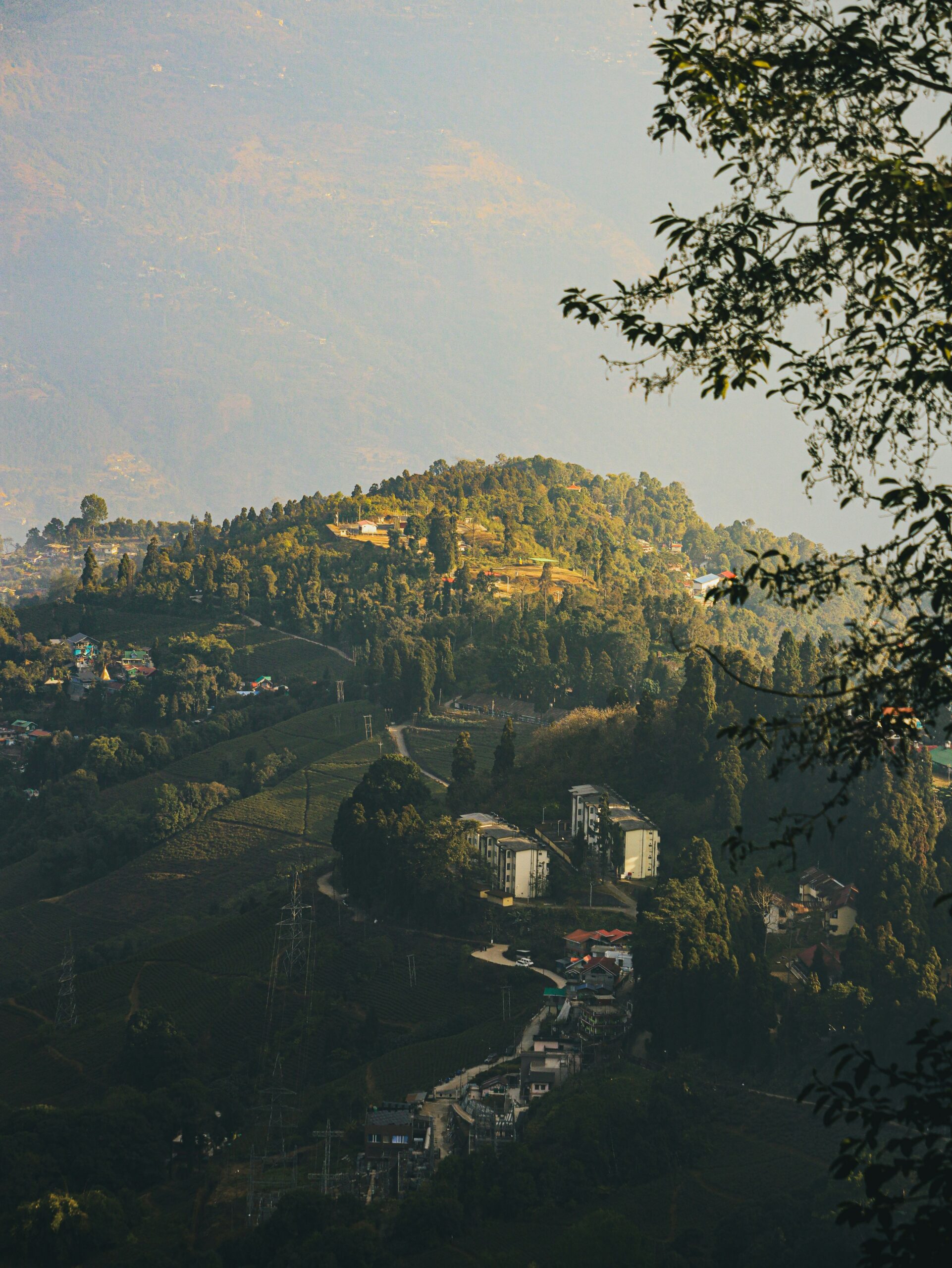
Himani’s room, on the upper storey of a bright blue building, backed directly onto a retaining wall. The signboard on the ground floor announced that it was a beauty salon named Gorgeous, but spelt with an i, which made it sound like the Italian names in Tuhina’s World History textbook – Garibaldi, Mazzini, Carbonari. Alia Bhatt’s oversized bridal visage from a recent film dominated the signage. The rain had turned her porcelain skin to parchment and the scarlet of her plump lips to a pale terracotta. Artificial colours faded quickly in the hills; natural ones returned with renewed vigour every season. Blossoms of the Himalayan autumn cherry that brushed the window on Tuhina’s side of the room had begun their colour burst. Any day now, the canopy would be like oversized scoops of strawberry ice cream piled atop bronze, shiny cones of trunks.
‘I can bring another bed, if you like,’ Himani offered as she put the aluminium kettle to boil on the single-burner stove.
‘No, I’m ok to sleep on the floor.’ It’s a thick mattress, better than the dorm’s,” said Tuhina.
‘Where did you get the charas? asked Himani, pouring steaming water on dried rhododendron petals and stirring a spoonful of honey into the infusion to make buransh tea.
At the start of every monsoon term, Charumati, Tuhina’s mother, sent over a bag of homemade and homegrown treats for her: plum preserve from the fruit of trees around Dol, fried semolina singla sweetened lightly, the way she liked it, and singori wrapped in malu leaves. The transit points along the route, of which there were many, dovetailed to ensure that deliveries from home arrived fresh for the boarders of Margaret Noble Residential Academy, especially when the homes were in villages. One of the shops near the bus terminal would send a runner up to the Manora – the everyday acronym for the school – for the final leg. The runners, who were always male and fit enough to make the three-mile climb to the school quickly, aroused considerable excitement among the all-girl student population. The fellow who carried the monsoon term hamper for Tuhina that day was spotted by many for the way his sun-bleached hair fell over his forehead and the crimson hoodie bearing the large-lettered Superdry logo. Even knock-off selections signalled the buyer’s taste.
Tuhina happened to be at the school reception when he arrived. He would have left the package and headed back without a word had the receptionist not read the name on the label and declared that the recipient was standing right there. Neither Tuhina nor the boy spoke, but a look went between them. The boy told the receptionist that there were many customers at the shop when the package was dropped off, as today was the weekly payday for wage labourers, which is why his father had sent him instead of the regular delivery boy. He added with emphasis, ‘Usually at this time I’m still at college. Classes end at 3, but today we got off early, so Baba said, Keshav, good that you are here; go run up to Manora.’
***
‘There are areas further north, towards Ranikhet, where they make it. Did someone from there give it to you?’ Himani prodded.
‘It was an equal partnership. I made good money.’ Tuhina finished the remaining tea in a big gulp and rinsed her cup in the sink.
‘But they didn’t find any money in your trunk,’ Himani pointed out.
‘My share is safe with my partner; he will give it to me when I ask for it,’ said Tuhina.
‘My third year internship was at the de-addiction centre. They call it Mukti Kendra. The addicts behave like prisoners, trapped in the drug’s painful grip,’ Himani said, placing her cup in Tuhina’s outstretched hand. Both rinsed cups stood side by side on the counter, resting on their chipped rims, broken handles turned away from each other.
Tuhina had not smoked a single stick herself. Every batti fetched two thousand rupees; she wasn’t going to burn up that kind of money in smoke. She maintained a record of sales, as her mother did of their household expenses. Charumati could cram a month’s accounts onto a quarter of a page. She tore blank pages from Tuhina’s primary school arithmetic notebooks and sewed them to make her accounting ledgers. She had been the bookkeeper for her SHG, which trained women to grow button mushrooms. Tuhina had felt safe when she looked at her mother’s tiny, neat handwriting. If you could sum up your existence in numbers, you had something to count on, something to plan with. Tuhina did not trust Keshav foolishly. She told him that if he tried to swindle her, she would tell his father about their clandestine arrangement. He had kissed her neck and said, ‘May a snake bite me if I cheat on you.’
A shout from the ground floor announced that dinner was ready. Himani had arranged with the landlady to take turns at the evening meal. That way, neither of them had to cook after work every day.
‘You have your little sister visiting. This is the bright one who got admission to the fancy school in Almora, no? You didn’t tell me she was coming, but that’s ok, we have plenty of rice and daal. You can chop up an extra cucumber for salad. And you, little girl, you also call me Fufi. Himani’s father is like a brother to me,’ said Monal Fufi. Tuhina expected to be quizzed, but instead, Fufi gave them a roundup of the clients who had visited the beauty salon that day; one of them might be getting married in the spring. She wanted bridal make-up like Alia Bhatt’s. Tuhina wondered if her mother had dressed as a bride for her second wedding; parched skin and pale terracotta lips.
Fufi suddenly remembered what she had missed placing on their steel plates. ‘Hima, the bhang chutney is behind you, on that stool. Take some. It will spice up the cucumbers; they are almost as sweet as melons,’ she said.
Cannabis chutney, staple in the hills, carried no intoxication, but, apprehensive of prejudice from outstation parents, the school mess did not serve the chutney made from roasted bhang seeds. Tuhina scraped the bowl clean when Monal Fufi asked her to take as much as she liked.
***
Himani left after a quick breakfast of tea and rusk. From the window, through the blush Padam flowers, Tuhina saw the flow of patients trooping into the lime-white building across the road. Most came on foot, some had motorbikes, but she could not see any cars parked outside the centre. At the start of school terms, students crowded up to count the cars that came to drop off what were called the FWS students, from the first world. They comprised the two-thirds-paying cohort, which financed the remaining one-third of EWS students. Out-of-state parents felt safer in bigger cars on mountain roads. In-state parents, a mix of small business owners, provincial government employees, and asset-rich but cash-poor landed families, drove up in budget vehicles. Keshav’s father owned a second-hand Celerio. It was taken out on special occasions such as temple visits and attending relatives’ weddings. Once, when Keshav’s parents had been out of town for Char Dham Yatra, he had taken Tuhina for a drive. She had sneaked out of the hostel at night, and they had parked near Crank’s Ridge, but couldn’t stay long because some rowdy tourists had picked the same spot for their beer party.
Thursday was Himani’s weekly day off. Tuhina was desperate to leave the house so she wouldn’t have to spend all day with her stepsister. She could go to the Dol Ashram to meet her mother’s friendly colleague, see if she remembered her thirteen-year-old self. Before she could announce her plans, Monal Fufi called out that there was someone to see them.
The girls sat on the stone chabutara that circled the thick trunk of an old Banj oak. Tuhina knew the man who sat opposite them on a blue plastic chair. Pavan ji was the community social worker. He and Tuhina’s father were drinking buddies who held their drinks differently. Charumati had to bear the brunt of her husband’s alcohol-fuelled abuse, but Pavan ji went home quietly to sleep off his drink alone. He was the one who had sent letters to Tuhina’s school requesting that they keep her there during the holidays while her mother sorted out her domestic issues. The letters, read out to Tuhina by the school counsellor, had stated that her mother did not think Tuhina would feel comfortable with any of the neighbours or relatives. What it really meant was that they would not feel comfortable offering shelter to an alcoholic’s daughter, even for a couple of months.
‘You’ve come home after three years,’ he said.
‘This isn’t my home,’ said Tuhina.
Parrying the sentimental provocation, Pavan ji said, ‘They’ve asked me to question you in the presence of a family member because you are a minor. They will make a decision based on my report.’
‘I am EWS.’
‘You think that matters here? There is a long queue of EWS students waiting to get in. Charumati is such a good woman; because of her, I recommended your admission. This is how you repay her?’
‘I get high marks. I have been the class topper for the last three years.’
‘Tuhina, you can’t go around with your marks pasted on your forehead. What gets seen is your behaviour. You must give them details of this narcotic racket you are involved in.’
***
There was no racket. Keshav was on grocery runs for a German tourist who was spending a couple of months in Kasar Devi, channelising the geomagnetic energy of Van Allen’s belt. The German was left with a hefty bundle of charas, sourced from the helper at the homestay where he was staying, when he had to return home much earlier than planned. He was fond of Keshav and gave him the battis along with a down bomber jacket and a pair of hiking boots that still had wear left in them.
‘He said he’d be happy to see me earn some quick money towards the SLR I’ve been saving up for,” Keshav told Tuhina.
‘What would be the first thing you’d shoot?’ asked Tuhina.
Keshav lifted her hand to his lips and said, ‘You.’
Tuhina slapped his shoulder hard with her hand, but she felt a warmth rise from her heart to her cheeks.
‘Because you’ll help me, that’s why. Those rich girls in your school, who are dropped off in their Hycrosses, they’d be perfect customers. They’d never tell anyone, especially not my father,’ said Keshav.
Keshav’s assessment proved wrong. One of the girls who had bought the charas from Tuhina bragged about it, and word got around. Tuhina knew it must have been the lanky one who, always seeking attention, bleached her hair blonde and pasted false lashes for the mixers with the boys’ school. Tuhina would have happily given her name in the interrogation if she believed it would help.
‘Who are you trying to protect?’ asked Himani.
‘Myself,’ replied Tuhina.
‘I will come again in a few days,’ said Pavan ji, getting up, ‘Hima, talk to her.’
Himani saw him off till the road, then suggested she and Tuhina walk down to the market to get chhole-samose.
‘You don’t have to be nice to me,’ said Tuhina.
’Fine. I am stepping out; if you want dinner, tell Monal Fufi,’ replied Himani in an even voice without any trace of rancour or relief.
Tuhina walked over to the ashram, only to find her mother’s colleague was away on an errand. The walk to and from gave her an appetite, so she went to the market to get chhole-samose for lunch. Many questions rose in her mind: how far was Himani going, where would she get dinner, when would she be back, but Tuhina did not ask any of them.
Over dinner, Monal Fufi answered them all without being asked. She said she worried for Himani, such a responsible girl, why could she not see that this man was a waste of time? He would undo all the reputation that Himani had built in the community with her nursing. People say she is better than the doctor. He can’t take care of himself; he could be of no use to her.
Tuhina remembered seeing the doctor yesterday, a red cross painted on the chest of his scooter. He stood on the balls of his feet, walking back awkwardly with the seat between his legs to pull back into a parking corner. He looked like a squirrel scrambling on a tree trunk to find a good spot to nibble berries. Once off the scooter, he had trotted to the clinic in a hurry with the agility of a young man.
Fufi went on, ‘Himani will not be young forever, and this man, so much older than her’. So, it wasn’t the doctor, thought Tuhina. Fufi had more to say. His wife fell from a cliff, died around the same time as Himani’s mother. You know, na, she died giving birth to Himani? Fourth child in four years, what do you expect? I think that is what attracts her to him: shared grief. If you ask me, said Fufi, the man may have pushed her himself. He didn’t beat her or anything, but she couldn’t get him to stop drinking his money away. She screamed and shouted. That works on children, not on grown men. Pavan’s wife should have left him, but she decided to leave the world instead. ‘Hima is like a daughter to me,’ said Fufi, wiping tears on the kurta sleeve of one hand and using the other to plunk a ladle full of daal on the rice heap in Tuhina’s plate.
‘You are younger than her, but you’re old enough to understand the situation. Your own mother, you’ve seen how she suffered. Do you think an alcoholic ever gets better? Not in these parts; they don’t. This Pavan will make her sad for life.’
***
Flashes of Pavan ji came to Tuhina; hunched in a plastic chair, head bobbing to her father’s inebriated rants, cross-legged on the stone dais by the Banj oak, singing her mother’s praises. Then a new sequence played before her; him making out with Himani, fumbling with her bra hook, and expressing his feelings in the loud, staccato diction typical of the villages around these parts. She placed the image of his soft belly against Keshav’s taut torso. It may be that, with experience, the objects of our attraction softened their contours.
‘Can I take this to my room?’ she asked Monal Fufi, picking up the bowl of millet kheer. Fufi nodded. Tuhina washed her plate and stacked it upside down on the counter to let it drain. She sat in bed, blanket pulled over the peak of her knees. The milk pudding was thick enough to eat with her fingers. She dipped two at a time and sucked the delicious sweetness off the tips. She used to eat it scalding hot, as soon as her mother took it off the stove. They spoke on the phone almost every week. The same conversations about landslides, forest fires, lakes drying up, creeks bursting their banks, and young people getting jobs in the city. When Tuhina asked about the separation from her father, Charumati told her to concentrate on her studies. ‘You can become a forest officer, Queeny, there’s no one like you,’ she would say. The Kumaoni expression for no-one-like-you sounded like queeny. ‘We will drive through Binsar in your open jeep, where tourists can’t go,’ she would add. Tuhina did not tell her mother that she had not chosen the science stream in class 11, which meant she was ineligible to write the forest service exam.
Himani stole into the room in the early hours. She lay in bed till it was light, then went about her workday routines. In the evening, she told Tuhina that Pavan ji had dropped by at the health centre.
‘He is going to Almora soon, to meet with the Principal. If you don’t give him any information, he cannot defend your case. You will be expelled,’ said Himani.
‘My mother is not here; they have to wait for her,’ Tuhina protested.
‘Some Belwal called him, said they have to make a decision by next week,’ said Himani, a sense of urgency in her voice.
‘And this Pavan ji is supposed to be my saviour, like he is yours?’
Himani shrugged and made to leave the room, as it was her turn to cook dinner.
‘Will he marry you? Will you marry him? A wife-murderer?’ Tuhina persisted.
‘He is no more a wife-murderer than my father. They both loved their wives. It’s just that they couldn’t make them happy,’ Himani said quietly.
‘Does he make you happy?’ Tuhina retorted, but Himani left without answering.
The next week passed with barely a word passing between the step-sisters. Tuhina burrowed herself in her textbooks. The sour cherry tree’s flowers were everywhere, jostling on the branches before dropping a mushy carpet on the ground below. When Tuhina needed a break from her reading, she’d draw a branch in through the window and feel the softness of the petals against her cheek.
Pavan ji came again one evening, with his report of the school visit. The Principal had kept him waiting till the end of the day. Their meeting had lasted more than an hour. He had taken the earliest bus and returned by a shared Sumo taxi because the last bus had left by the time he reached the terminal. He had told Mrs Vasisht and the teachers about the alcohol abuse at home, Charumati’s work for the community, and Himani’s entry into the family, implying that the younger girl had a role model. His legal research had revealed that the quantity of charas was well below the threshold for a heinous crime, ruling out any hassle from the courts. He had explained that some women hikers from the Netherlands, who had since left the country, had passed the charas to Tuhina in the market, and she had been stupid enough not to throw it away. There was no peddling, and no racket. In short, he had extracted leniency for Tuhina. Then he added, ‘I have more news.’
The school had been informed by the State Education Board that Tuhina’s Class 10 score was the highest in the district. It was the first time that a Manora girl, that too an EWS student, had featured in the merit list. The six district-level toppers and the overall first-ranker were to be felicitated by the Principal Secretary of the Education Department in Dehradun. There would be a cash award as well.
When Pavan ji finished, he looked at Himani. ‘Pavan ji, everything has worked out because of you,’ she said. Tuhina, without thanking Pavan ji, asked Himani if she could return to school the next day.
_________________________

Java Ravi lives in a mountain town. Long, long ago, she ran a flower farm in the hills where tulips and lilies were grown for the international market. Then, somewhere along the way, she fell head over heels for Latin American literature, which led her to spend a few years teaching in the Spanish department at Doon University in Dehradun. She began a new chapter in her life in 2024 by attending a creative writing course. She loves stories in all shapes and sizes, but is partial to Junior and YA novels, which she hopes to write one day soon.
_________________________
Photo by Rohit Sharma on Unsplash
Find MeanPepperVine on Instagram @MeanPepperVine


What a beautifully real everyday story told in a gentle way, enmeshed in nature’s bounty and a frugal and immensely nurturing environment. Enjoyed reading it. Looking forward to more stories from Java Ravi.