| Debi Mukherjee | April 2026 | Short Story |
I lay at the edge of the bed in a foetal curl, the bedsheet crimson underneath me like a wilted hibiscus petal. I pulled up my duvet to conceal it, clutching onto it. Outside, the wind howled with a temper I had not heard since the monsoons had waned. One of the window bolts had come loose, and the panel kept flapping against the frame, impatiently.
In the mirror facing the bed, I could see my face—ashen, hollow-eyed.
Winter in Mumbai was hardly winter at all, not so different from my childhood home in Panjim—warm, even languid with salt and humidity. But this sudden December rain sent a tremor through me.
Across the hall, Tanay moved quietly inside the nursery, supervising an installation. The nursery was in a perpetual state of work in progress. I could hear the low scrape of furniture being shifted, and the dull rhythm of a hammer from time to time.
But he would be conciliatory. Like every other time. He would call the obstetrician, schedule another appointment, and then return to his workday. After twelve years, however, a numbness had set in when it came to dealing with it. Years of consultations and repeated fertility treatments. First IUIs, then I had IVF procedures. I could smell the sterile corridors of the clinic even in my sleep.
***
I must have drifted into a slumber because when I woke, the storm had softened to a slow drizzle. From the table clock, I deduced it was early morning.
Tanay had gone downstairs to the grocery store for milk and eggs. I was grateful for not having seen him yet, as I had yet to gather the will to meet his eyes. Just one quiet weekend, before we deal with it. Again.
The kettle hissed softly as I set water for tea. My mind felt strangely vacant. When I walked towards the refrigerator for the milk, I noticed a sticky note fluttering against the surface.
It said in Tanay’s hand: Baby, are you ready for a short trip back home?
Because mommy too was a child once.
I smiled faintly despite myself. He had been suggesting for months that we should visit Panjim, the city where I had spent the better part of my childhood and that we had never found the time. After the second trimester, it would get more difficult for me to travel.
***
The sky hung low and pewter-grey as we drove along the Mandovi river. The backwaters stretched quietly toward the Arabian Sea, dark as ink beneath the shifting clouds. A pod of pelicans glided across the horizon, their wings moving in an unhurried synchrony. By the time we reached Dona Paula, the sky was dissolving into shades of magenta, the sun already conceding the day. The tide surged restlessly against the cliffs as our car wound closer to the sea. I tried my level best to limit interactions with Tanay and instead stared out into space.
Ave Maria, the mansion where I had once lived, had been remodelled into a modest seaside hotel almost a decade ago. However, its old stone path leading toward the sea had remained unchanged, still half-swallowed by grass.
Tanay stayed back with the luggage, answering a few calls, while I wandered down the path alone. It was high tide, the waters impatiently thrashing against the rocks, jolting me back to the present. The waves shimmered like liquid silver. If I ventured any further, I could fall into its embrace. For so long I had missed this beauty. I sat halfway down on a rock and waited for the sun to surrender itself into the horizon, as I let memories wash over me.
When I was ten, I would sit beside my grandmother, an ice lolly in hand, to watch the sunset. Dad worked in a senior capacity at the Colgate factory, and his posting brought us to Goa for over a decade. But home was also Delhi. And Mumbai. Cities through which my parents and I drifted as I grew up, moving from one address to another like modern-day nomads. Yet it was here in Panjim where I spent the most impressionable years of my childhood, and I hold them closest to my heart. My grandmother said that a perfect family was an abundant family with the sounds of young voices. She sat by the window and sang softly to the birds on the balustrade.
“Are you singing to them, Thamma?” I asked curiously.
“They carry our messages,” she said, turning towards me with a hopeful smile, “to the people we have loved and lost.”
An old song rose to my lips too—the one our music teacher at Mount Carmel, Father Emmanuel Rodriguez, had taught us. I watched the sun lowering itself into the sea and hummed under my breath:
Poor little turtle dove, sitting in a vine
Mourning for his own true love,
So why not me for mine, for mine,
So why not me for mine?
The wind carried the tune away across the water, where the evening light trembled over the restless waves. A white seabird glided suddenly toward the rocks and landed a few feet away from me. Her feathers were startlingly pale against the darkening sea. She pecked at the moss along the stone with a quiet deliberation. I lifted my phone instinctively to capture the moment.
“Hello! Birdie, who are you,” I murmured under my breath.
The bird tilted her long neck toward me.
I had lost the lines.
I’m Nobody! Who are you?
Are you—Nobody—too?
Then there’s a pair of us!
Don’t tell! they’d advertise – you know!
How dreary – to be – Somebody!
The bird watched me with a calm, unblinking gaze as I took the words in. Despite the gust of wind blowing from the sea, she was perfectly audible. And then, she took flight.
“I missed it by seconds, didn’t I?”
I jerked back. It was Tanay tapping at my shoulders. I nodded, flicking away a single tear.
“You know what, I am too tired,” I say, looking up at him.
“Oh, didn’t you say we would walk to Dona Paula for dinner? The sea lights up with the blue turtles, right?”
I nodded. “I used to know one spot where they bred. They looked magical.”
“Sure.” He let out a soft whistle, gazing around at the cliffs, which looked as though they had been lifted straight from the canvas of Claude Monet.
“Then let’s go to our room. I’m famished.”
***
The restaurant by the beach stood like a weathered memory at the edge of the Dona Paula promenade. A striking silver-haired woman greeted us at the entrance.
“I’m Susan Garza,” she said warmly. “Please call me Susie.”
We introduced ourselves to the gracious hostess.
Susie had a relaxed and sophisticated taste about her. She was wearing a pristine white billowing dress that fell up to her knees. Her silver hair pulled back loosely in a chignon. Little fringes fell over her forehead that flew gently with the sea breeze, occasionally giving off a cerulean glint.
“These are stunning! What are these depictions about Susie?” I asked admiringly.
Inside, the walls were embedded with cowrie shells forming murals of waves and turtles. The room smelled faintly of woodsmoke, garlic, and salt. While Tanay scrolled through his phone, I watched the tide advancing in slow, deliberate folds. Murals with multi-coloured cowrie shells were on the plastered wall, depicting a turquoise and white sea. Waves were teeming with giant jellyfish, mermaids curling up at the shore and blue turtles bobbing on the waves. It looked like a time capsule.
“Ah! That’s a long story. Centuries ago. Arms and ammunition were loaded here. At one time, my ancestors had used these to annex the coastal belts. Back then, sailors often associated the shiny blue light in the sea that we now know as bioluminescence with a phenomenon they called St. Elmo’s fire— a divine sign, a manifestation of the Holy Spirit.”
“Really!”
“Yes. They owned lands along the coastal belts for centuries. So, these cowrie shells plastered through the walls? These were used for trading.”
Through her thin, dark shell rimmed glasses, her deep ochre eyes held a smile that travelled up to her lips as she spoke, “Cowrie shells were currency back then, yes! They would source them from the Maldive Islands by the millions.”
“Please make yourself at home,” she said genially and flew to the next table, allowing me time to peruse the options from their menu. I picked the options and delegated Tanay to place the food order.
I watched the sea beach at the far end of the promenade. Tanay was still on the phone, waiting for the server to arrive. I decided to take a quick plunge into the sea. I yanked off my pullover, I bent down to remove my skirt, revealing my yellow swimwear underneath. By the time he could look up, I had strolled out of the eatery down the beach.
When ruminating on our marriage— I only know that our counselling sessions have helped only a little. Tanay had been unavailable through the emotional turmoil of the miscarriages. Except when he could help it, at the suggestion of our counsellor. And then, a chunk of our earnings was being drained in procedures. The doctor had even suggested that we remain open to all options, like adoption too, while not losing hope on fertility treatments. But the second failed IVF felt like a wake up call to me. Tanay had been distraught too, I suppose. Like ‘horses on blinkers, ’ we had been riding towards something that we only imagined through the lenses of our society. And after all these years, I do not know if I even want it anymore.
Breathe in and breathe out, Sheila!
I undid my hair, letting the sandy breeze flow through it. Lifting my hands up to the sky, I looked up; the sky was blue again. My grandmother’s voice floated faintly in memory—her warning never to swim too far. But the tide felt strangely gentle. I floated on my back, gazing into the pale afternoon sky.
For years, my body had felt like a question I could never answer.
Why had it failed me? Why did I carry this guilt?
Am I not enough?
I wanted to scream, to cry.
The waves lifted me, cradling my body for a moment before lowering me again.
A feeling of unbearable lightness permeated through me as a pod of pelicans hovered by, distracting my thoughts. I let the waves wash over my feet. The sun delighted on my caramel skin. Slowly, with every breath, I began to relax. The water was cool and the coarse grains of the sand acted as an exfoliant, abrasing gently on my skin. It felt luxurious. The waves lapped on me repeatedly in answer, Sheila…
go
easy
on
yourself
I began to float facing the sky, feeling the lightness again.
Feel
the
water
lapping.
Gently.
As if I were shedding layers of weight that I carried on my shoulders. I flipped around to view the seabed, my eyes flaring with the sea salt. Life underneath went about their day, unperturbed. A few dozen clams swam by me merrily. To my right lay a long row of corals. Let’s pause here.
I sauntered back to the beach.
***
Back at A Cozinha, an ambrosial whiff beckoned me to my table. Wrapped in my towel, I sat down to a decadent meal. The sea and the sand had heightened my senses; it was not surprising that at half past noon I was famished.
“Crab Xacuti and Poi,” the server announced. I kicked back, sipping on my chilled drink that had beaded up considerably on the outside. Tearing the Poi at an angle, I dipped it in the yellow-orange crab curry. The drunken bread burst into a song on my palette. The perfectly balanced coconut curry, with its tanginess from the tamarind, punctuated by the heat from the chillies, felt satiating, accompanied by the soft and mildly sweet texture of the bread. I extracted a pincer full of flesh from the claw and bit into it. It was succulent and sweet. I felt nourished. Healed by the sea’s vitality. A mother. Before we could find Susie to share my compliments, the server reappeared with a slice of warm Bebinca drizzled in cocoa powder. He placed it gently before me, saying, “with compliments from Mrs Garza” Accepting the plate, we conveyed our heartfelt thanks to the gracious hostess. Tanay went down to the sea for a dip as I sat back, enjoying the view of the sea.
***
As I grew older and more difficult to manage, my grandmother took me to the promenade. With the guardrails on, she wouldn’t need to run after me. And with time, I stopped accompanying her to the sea because of her anxiety. I chose to visit with Mum or Dad occasionally, when they were free over the weekends. And then one day, I woke up to learn that she was gone. My grandmother had passed away peacefully in her sleep. I only learned years later from Mum that while my grandmother was pregnant with my father, the sea had taken her husband. They had been holidaying by the coast. One afternoon, he went out into the water, and the tide closed over him. He never came back. Until then, I was never certain of the cause of my grandfather’s death.
***
In the evening, I strolled back to a corner of the promenade that led directly to the beach. The sun was midway into the sea. The water began to darken, as if a child had poured his bowl of water after using it to wash his paintbrushes. Then, all at once, I caught sight of a dozen or more electric blue webs floating about. Gradually, the shore lit up. I quickly texted Tanay to walk back to my spot.
I bent down to watch a bale of glowing lattice-like discs of turtle shells— hard yet slimy! So beautiful was the sea that it was shocking. My classroom lectures floated back to me on the symbiotic relationship of algae and turtles. The enchanting beauty and vastness of the place brought a sense of weariness in me. Oh, how dreary it is indeed to be Somebody.
A melodious voice hailed out to me, “Oh, hi, that you Sheila?”
I waved back at Susie.
She walked up to join me, lighting up a cigarette. “I hope you don’t mind?” she asked.
I shook my head.
She asked casually, “So you too like the shiny turtles?”
“They are bioluminescent.”
She shrugged.
“They are not emitting light at all.”
“Then who is?”
“Little lives on its shells! Marine organisms like, algae and planktons and such.”
“You don’t say!” Her eyes sparkled, reflecting the blue of the sea.
“It’s a symbiotic relationship. Both living things share a common habitat from which the species benefits.” I smiled, feeling humbled, the verses of Emily Dickinson still ringing in my ears.
We fell quiet. I took a few puffs from her cigarette when she offered.
“I’ll let you in on a secret,” she said at last.
I waited as she doused the cigarette.
“At times our spirit dies down. Fades. Much like the crests and troughs of a wave, no?”
A lump was forming in my throat. She gently tapped my left shoulder and smiled.
“Every now and then Sheila, we deserve a bit of magic. To survive.”
When it was ten past seven, she had to walk back to her kitchen. We exchanged our goodbyes. As I strolled under the street lights towards my hotel, I caught a glimpse of a silhouette soaring above the waves as though flying in my direction— catching the iridescent light of the sea.
***
I could see the lights in our room. Sade’s voice was crooning Somebody Already Broke My Heart, from the record player. Tanay was waiting for me, although I had texted him.
He had to finish a quick call that had held him back at that time. I gathered the will to speak to him after dinner.
In a restrained voice, almost under my breath I said, “Tanay, I cannot do it again.” I could tell that my voice was trembling.
“What happened?”
“The baby. I lost it..”
“When?”
“Two days back.”
He sat quietly, looking down.
“I cannot go through it anymore.” I wept.
He came close to me and held me in his arms.
“I am sorry that you couldn’t share it with me.” His voice was sincere.
“It shatters me each time Tanay! I.. I don’t think I want it anymore!”
“Shhh…I always thought that it was what you wanted. It is okay. We are okay!”
I let my arms drop and closed my eyes, exhausted by the confession. I know I had to deal with our family too. But that could wait.
***
Tanay was asleep. I padded over to the veranda attached to the room, feeling a buoyancy in me I hadn’t known for years. A gust of the sea: the grainy sand and salt blew at me as I opened the door. A white creature sat on the railing. Was it a vision? An apparition! I strained my eyes. She was the one from the previous day— fantastical even against the dark horizon of the endless sky! Her silver crown glinted with a hint of cerulean sheen as she turned to look at me gracefully. I looked out at the cliffside of the sea which still glowed warmly with the light and the verses floated back to me:
How dreary – to be – Somebody!
How public – like a Frog –
To tell one’s name – the livelong June –
To an admiring Bog!
Tranquil at last, I unfurled my arms to the air.
_________________________
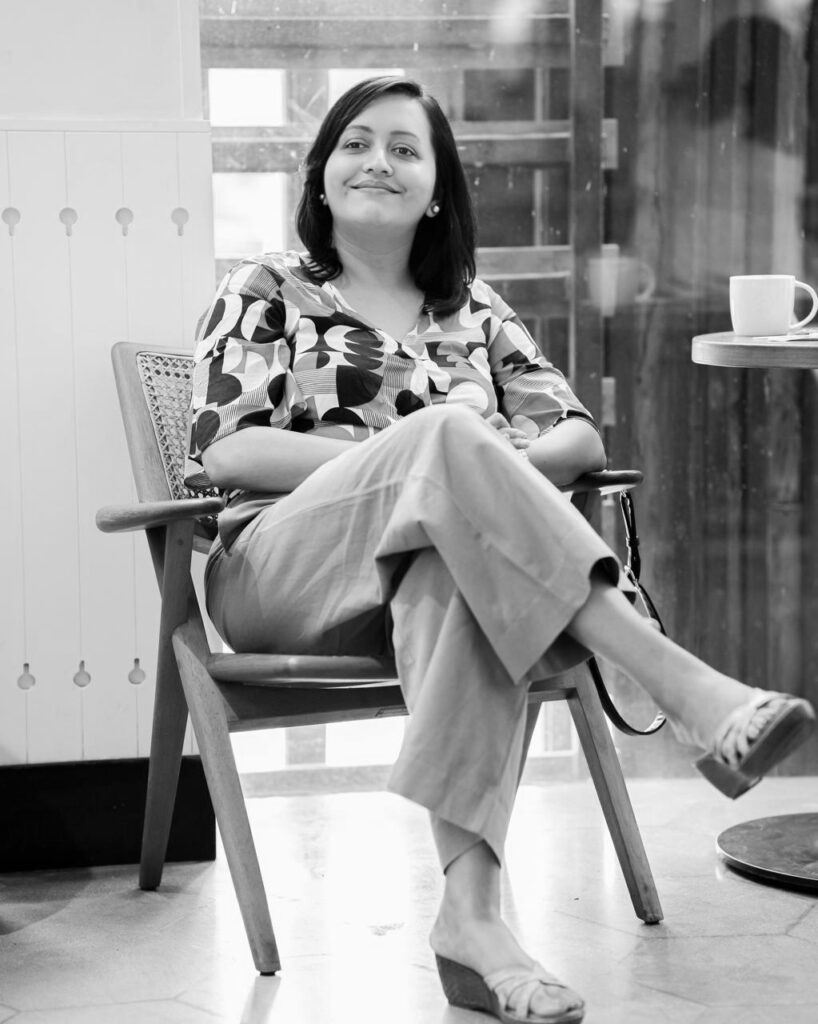
Debi (Debarati) Mukherjee writes fiction, essays, and poetry exploring identity, resilience, and the complexities of human relationships. Her work has appeared in magazines such as Usawa Literary Magazine (2025) and Kitaab (2026), and in the anthology The Hours of the Sun (2024). Her short story In the Pursuit of Earths was among the top Eco-fiction stories and is featured in a special issue of The Hemlock Journal and Remington Review (2026).After eighteen years in the corporate world, she embraced her literary path and committed herself to the craft of storytelling. When she’s not writing, she loves to swim and spend time in nature.
_________________________
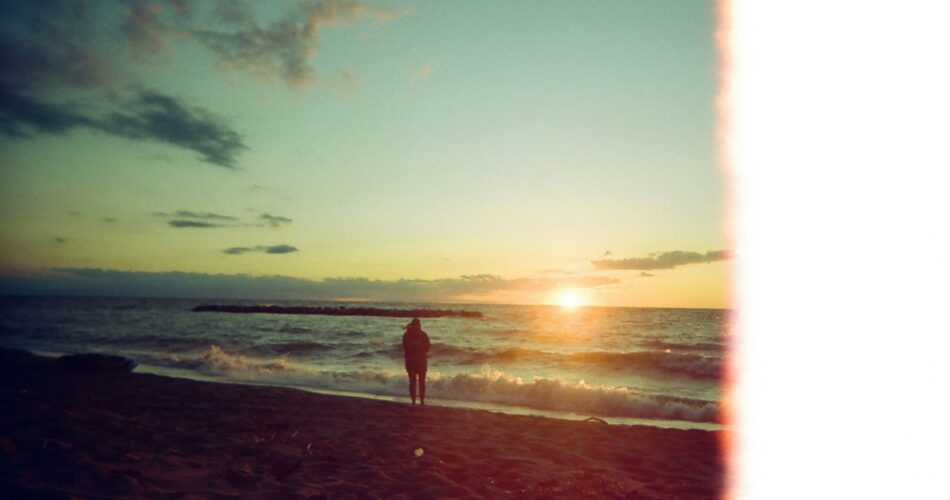
Photo by Kat Kelley on Unsplash
Find MeanPepperVine on Instagram @MeanPepperVine

Beautiful description of Panjim. Could sense the salt in the air, the humidity on the leaves….a very well written piece. The themes of continuity, guilt are beautifully etched out.
Beautiful read …