| Shivangi Gajwani Jain | October 2026 | Short Story |
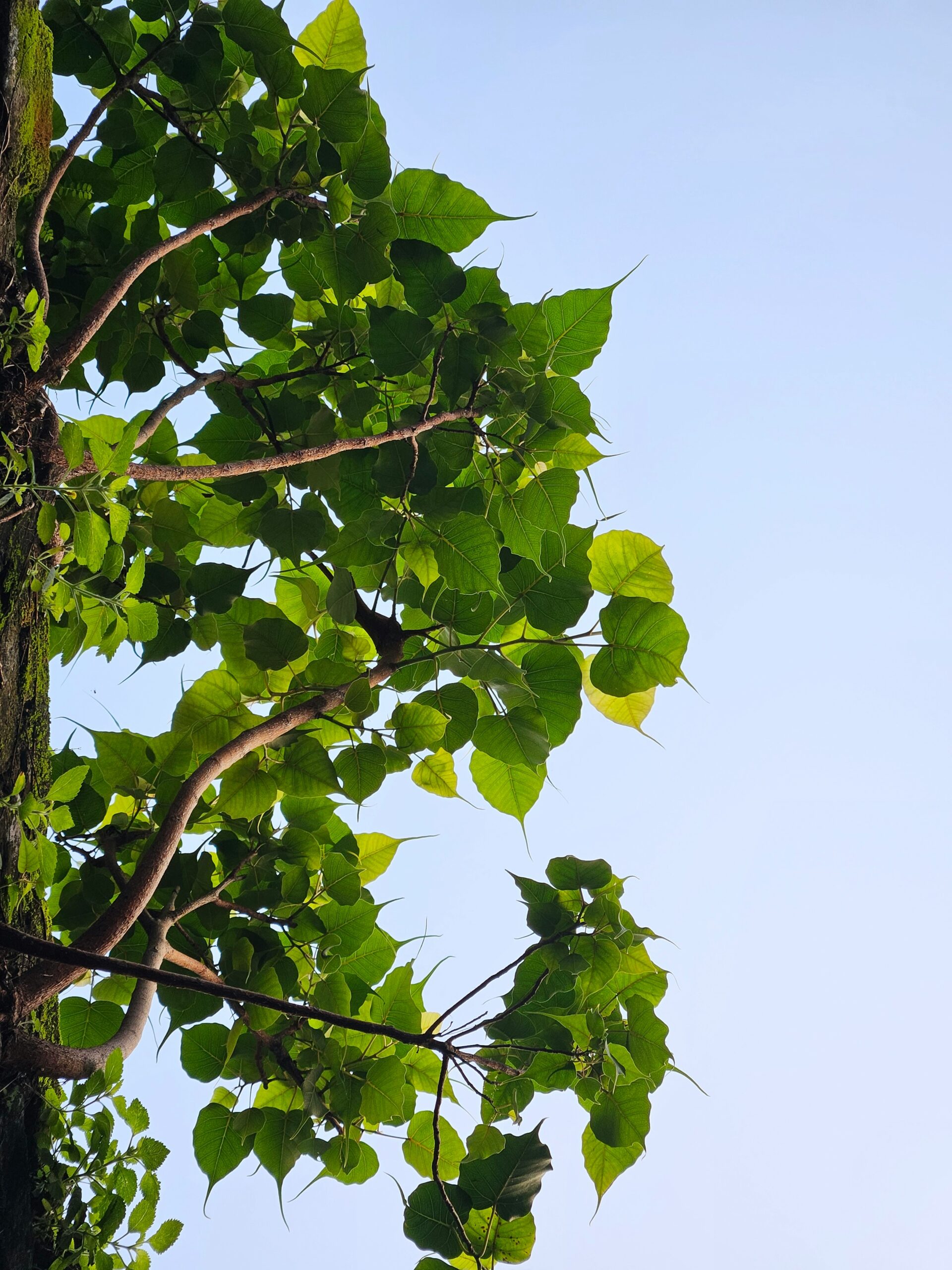
I live under the shadow of a large banyan tree. It stands outside our house, on a narrow, dusty lane that runs between closely stacked houses. But this tree is mine. Half of its branches, with its many drooping roots and leaves and their dappled shadows, fan out above my room’s balcony. Sometimes, when the wind flows in a particular way, the tree speaks to me, and sometimes, it listens. It’s a friend and a therapist combined.
Maa complains about the clutter and the tiny wildlife the tree brings with it. Vibrant caterpillars and butterflies, plenty of ants and spiders and bees, occasionally even songbirds, hop onto the balcony and into my room, especially in the rainy season. I don’t mind.
Every June-July, when Mumbai’s infamous rains are a constant in our lives, the tree becomes thick and green, lush and majestic, teeming with life. White, velvet-soft mushrooms, with little stems sticking out from their pedunculated neck, appear on its bark. They always make patterns as they sprout. Today, they are sprinkled upon the tree, closer to its base like a staircase. Perhaps, for tiny fairies with tinier feet to climb upon. Today, they are magic.
“Good riddance,” Maa says, switching on the water filter, arranging empty glass bottles near the sink. The filter’s off-tune song begins to play as she waits for the red light to turn green.
“What are you talking about?” I ask, lighting the incense stick and winding the orange-red mauli[1] around the pillars of our small marble temple. It houses three deities, Ganesha, Shiva, and Goddess Durga, seated on a lion, and is tucked beside the fridge. It’s not unusual to have gods in Indian kitchens, as they are often among the cleanest places in our homes.
[1]Mauli: A religous thread, ‘red and yellow’ tied around the wrist and/or sacred objects as part of Hindu rituals.
“Our community is finally ‘concretizing’ the road outside our house,” Maa announces it to me, to the Gods, and the room in general.
“The community? Not the government?” I ask, distracted, as I apply a dab of vermillion to each deity.
“It’s a small patch of land Meera, it will take long before the government wakes up to our needs. The residents’ association is getting the work done. It was long due, if you ask me.”
“Hmm,” I bow my head and bring my hands together.
The filter’s song abruptly stops, and clean water flows out of the tube. Maa puts a bottle under it and gives me the news.
“Oh, and the banyan tree will be cut tomorrow morning to make way for the road. A notice has been issued.” She tells me casually, switching bottles when the water overflows from the first one.
“But Maa, that is my tree. It’s been a part of our lives since before I was born.” I say, grappling with her words. “What about conservation, keeping the societies green and nature-friendly? Aren’t you part of the association?”
“That tree is a nuisance, Meera. It sheds more leaves than it grows, and the insects,” she shudders, “Ughh! You know how I hate them, and the mushrooms.” She throws her hands up in exasperation. “I am certain they are poisonous if not plain ominous. The tree might be decaying already.”
“That makes zero sense,” I mutter as I walk out through the side gate and stand directly beneath my room’s balcony. The banyan tree looks somber, like it is privy to our conversation and its doomed fate.
“Decaying? Bah!” The main trunk is a healthy, brown and very sturdy, while many aerial roots hang from its branches. Some have pushed through the ground and formed additional thinner trunks. ‘Don’t they see? It’s not just a tree, but a forest of many.’
I touch its bark with reverence and belonging. An ant climbs onto my little finger, then quickly climbs back down. A sparrow flies into a small nest, nestled onto one of its branches. I can’t see the baby birds from here, but in the early mornings, I can hear their chirps and squelches and squeaks. Even the tiny mushroom-heads look towards me with hope. How will they come back next season, if there is no tree to call home!
‘What can I do?’ I wonder, thinking of all the tree-saving stories, new and old, which I have seen on Insta or read on Twitter. ‘There must be something.’
“I could try the ‘tree hugging’ way,” I say out loud, “The Chipko movement.” It had worked when villagers in Uttarakhand, particularly, when women hugged trees, so loggers couldn’t cut them.
“Maa would get annoyed though,” I mumble. “And I’d look rather foolish too, standing in the rain, hugging a lone tree.” Questions come and go as I stare and think and stare some more.
‘How long can I stand to protect the tree? Will hugging really work? When should I start? Now, or in the morning, when they get the chainsaws and the stump grinders. What about tomorrow’s classes?’ My head hurts and so does my heart. These campaigns require public intervention, mobilization of grassroot organizations, and probably political pressure. Whereas here, it is – just a single tree and me, it’s only ally.
I take out my phone and click photos of the banyan from all angles: the trunk, the roots, the branches and the shade provided, even the nest. ‘Maybe I can make a reel and hope that it goes viral.’
I shake my head at the absurdity of it all. I have made many reels in the past, and nothing has ever gone viral, ever. “It won’t work,” I grumble.
“Meera?” Maa calls. Her head appears at the kitchen window, a frown etched across her forehead, visible even from a distance. “What are you doing, talking to that tree Come on in and finish your prayers. You know we take our Gods seriously.”
I sigh, temporarily defeated, as I slowly walk back home. That is when her words sink in, and I realize, ‘We do take our Gods seriously.’
I may have a plan, and it might just work.
***
The next day, the tree still stands.
A wave of relief washes over me as I enter the house. Maa is sitting on the sofa, watching TV. I take a deep breath and sit beside her, bracing myself for what’s to come.
“Maa, I am sorry.” I say, holding her hand. She turns down the volume and looks at me.
“About what?” She asks, with a curious twinkle in her eyes. She wants me to tell her what I’ve done. I know she already knows. The temple sits empty.
“Umm…” I stammer. “I am sorry for taking our Gods out of the house and tying mauli around the tree without your permission.” She is silent. “I didn’t tell you because I thought you wouldn’t agree.”
“You are right, I don’t agree. But I understand.” She pats my hand. “We can always buy more Mauli, Meera, and bring new deities from the market.”
“You are not angry with me?” I ask, surprised.
“Annoyed, yes, but not angry.” She glances towards the empty temple before handing me a small, wrapped bag. “I got this for you.”
I open it. Inside is a little statue of Hanuman, the monkey-faced God of protection.
“Go. Place him with the others on your sacred tree. Together, they’ll keep it safe.” She finally smiles, then winks. “And don’t forget to say your prayers.”
“Maa,” I whisper, then swallow, for words are not enough. I pull her into a tight hug. “Thank you.” And then, I almost skip through the side gate onto the dusty street where our tree stands.
The banyan with its branches and leaves, and the things that call it home, sways gently- inviting. Orange-red threads are wrapped around its many trunks, thick and thin, and three deities sit safely in the nook of the main bark. At the base of the tree are several offerings: a coconut, colourful flowers, an old kalash and multiple tiny bells, which I do not recognise.
I place Maa’s Hanuman idol next to Durga, our fierce Goddess. While our neighbour from the house opposite ours offers flowers and lights a diya.
“Meera, did you know that banyan trees are known to be hallowed, connected to the divine? Apparently, cutting one with mauli wrapped around it can bring a hundred years of bad luck.”
“Yes, aunty.” I touch the threads and say a loud prayer, just for her benefit.
“Someone pious must have placed the Gods here.” She says and bows twice. “Thankfully, your mother told us about the omens, and the committee agreed to build the road around the tree instead. Best to leave soft mud here and make a boundary around it to ensure the roots remain protected. How fortunate we are to have your devout mother among us.”
I nod. A happy smile plays on my lips as I say, “How fortunate.”
_________________________

Shivangi Gajwani Jain is a practicing dentist, published academic, and a lifelong storyteller. Her work has appeared in Gordon Square Review, The Adelaide Lit Magazine, The Quasar Review, The Hemlock Journal and elsewhere. Her story ‘The depravity of this world’ was shortlisted at Mumbai literature festival 2025. She lives in Mumbai, India with her family.
_________________________
Photo by Anmol Agarwal on Unsplash
Find MeanPepperVine on Instagram @MeanPepperVine