| Drishika Chiriapanda | October 2026 | Short Story |
Ganga sat perfectly still on her bed, propped up against two stiff pillows. Shadows loomed on the wall opposite her as the sun set on the courtyard behind. She didn’t dare make a sound.
Next to her bedstand, her newborn child slept in a wooden crib. Ganga kept her gaze fixed on the door ahead, trying to recollect the face of this child. There were two eyes, sparse eyebrows, a nose and something like a freckle next to it, yes, but all the details were hazy. She turned once again to the sleeping child, trying to commit the face to memory.
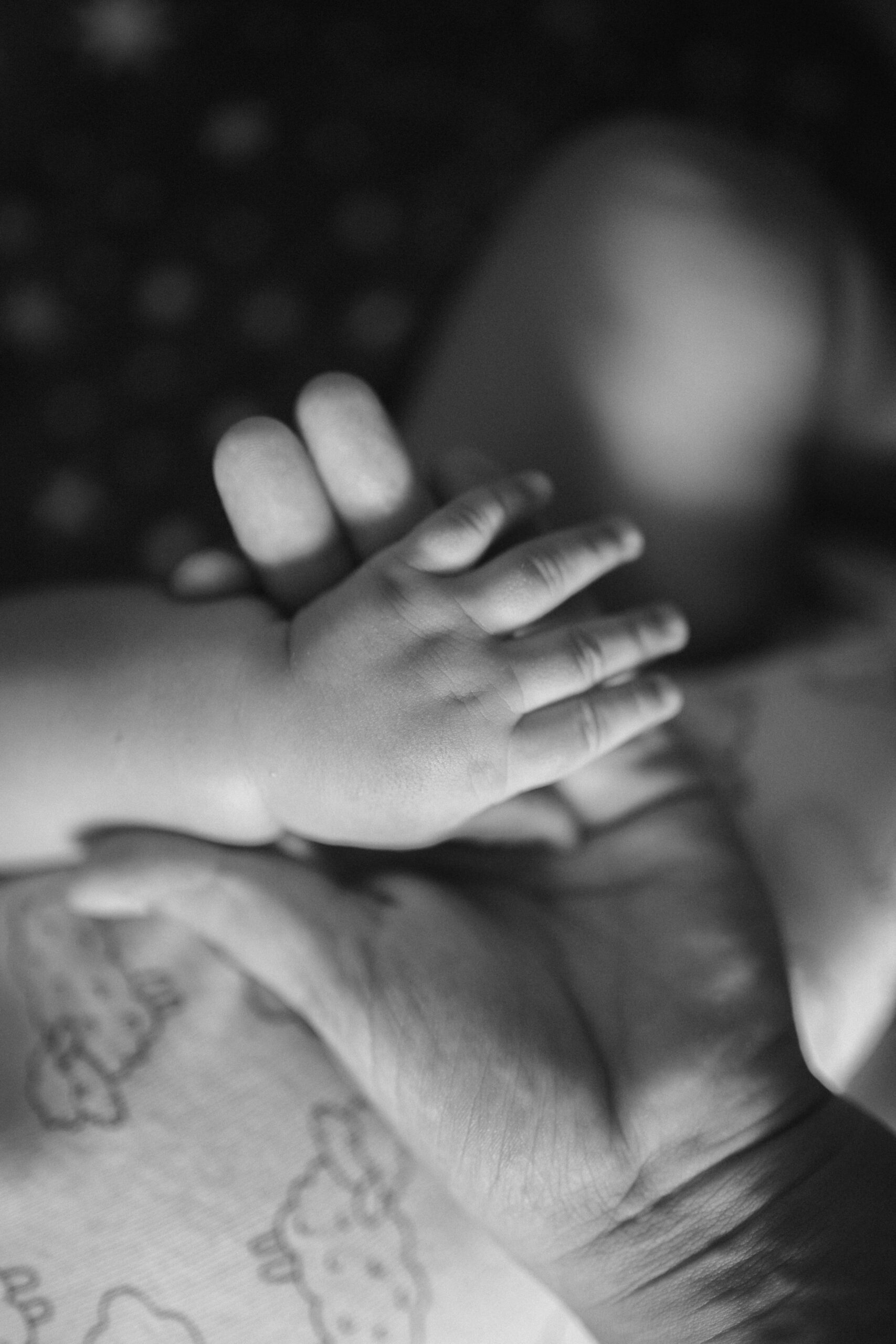
As she watched, one fist came free from the swaddle, clenching and unclenching, as though reaching for some invisible token in the night.
Ganga softened at once, watching the small fingers feel the air. What was she to do if the baby stirred now? The whole day she had women milling around her, helping her conserve energy, teaching her how to nurse, changing nappies without being asked. Now they had simply left her alone with this child, a stranger really.
“The child will need to feed, best you keep her near your bed,” her mother, Leelamma, had said. There was only one wet nurse in the village, and she was already occupied. “It’ll get easier with time, we’ve all done this,” her mother had continued.
The single brass oil lamp on the bedstand cast deep shadows on the stiff cotton blinds and wooden shutters. Her slippers and socks were scattered on the polished red oxide floor near a steel almirah. Another wooden shelf opposite the bed now held a cane basket filled with soft white towels, cloth nappies, and cotton swaddles. So many things, for such a small being.
From the hearth behind the kitchen, faint smells of smoke and drying pepper drifted in.
She had just been entering a disturbed half-sleep when her husband appeared, at last. She roused herself, rearranging her face into what she hoped was a smile, and watched him step barefoot through the doorway, clumsily avoiding eye contact. It was dark outside, and the brass lamp’s flame had dimmed.
The child let out a whimper. A small, pitiful sound that stopped as quickly as it started.
The new parents looked at each other.
She could see that he was lost; completely out of his depth. No smart observations or quick wit. Just a young man who had no words for his wife who had just given birth. Fatherhood had not been a journey for him, it had just happened – was just happening. Just like that. His hair was windswept, his checkered shirt creased after a full day’s work.
He held his palms locked close to his chest as he saw the baby’s chest rise and fall, not trusting himself to touch such a delicate thing just yet.
She tried to imagine what he was seeing – how this small room must appear through his eyes. How he must want to know everything and nothing, immediately and at once. He sat at the foot of the bed, lost in thought.
“Has she had milk?” he asked in a half-whisper.
“Yes. A little.”
“Only a little?”
“The baby will be tired after birth too. That’s what they all said. She will drink more in another day or so.”
“Ah.”
“Yes.”
He could express gratitude for their safety. He could say that he was glad everything had gone well. Or he could ask how it had happened, how it had felt. She could describe it in detail, it was still vivid, etched into her brain, in the fabric of her being. She worried it would never fade.
Leelamma had made the preparations, assisted by other experienced midwives and women from the area. Ropes hung from the rafters, water boiled in two large bindiges, and a thick unyielding mat was pushed closer to the kitchen hearth where the fire burned hot. On it, multiple clean white cloths and old cotton sarees. She hadn’t understood the purpose of those until the end.
“Do not shout and scream, there is no use. Use the pain to push,” a woman had admonished her, she couldn’t remember which one. But in that final stage, there could exist no reason or premeditated effort.
By the end of the ordeal, everything was bloodied red.
The midwife promptly cut the umbilical cord with the boiled and cleaned blade of a sickle. She called out for a second blade, hot from the hearth. With this, she sealed the wound and applied turmeric to prevent sepsis.
It felt like immense pressure, lifted. Her long, black hair was drenched in sweat, as was the mat beneath her. And then the child – this child – had been pushed into her arms to be fed. But the baby had stopped crying almost immediately in her arms, like she knew that she was home again. And wasn’t that just wonderful?
Ganga looked at her husband, tears pricking at the corner of her eye.
“Don’t worry, we can always try again,” he said.
Ganga stared at him, uncomprehending.
“Some people try seven or eight times before they have a boy. You take rest.” He meant to be kind, she could tell. He meant to assuage. The child whimpered again, as though offended.
“She can hear you,” Ganga said, except it came out sounding sharp, emotional. The wind howled outside, and her hands instinctively reached to refasten the baby’s swaddle. Her husband left shortly after. Something about travelling tomorrow, to share the news with his parents.
Ganga felt a deep weakness settle in her bones.
The child squirmed again, pushing against the newly fastened swaddle. The midwife had said babies needed to be bound firmly, that they enjoy the resistance and sleep better for it. Yet, here was the child, seeking to push apart the folds as soon as they were around her.
“Pay no attention to it,” Leelamma said, as Ganga repeated her husband’s words the next morning. “Men will always want to move on to the next thing.”
She was a brusque woman, her mother. All hard lines and sharp edges. For a long time, Ganga detested the light, floral, cotton sarees she would drape, so at odds with her rough, methodical nature. Not much had changed.
“I never let any child of mine cry for this long,” Leelamma said, almost a week later. “Be quick with it.”
Ganga was unfastening her blouse. Her fingers felt sluggish and heavy. The child had to be fed round the clock, and her milk was slow and painful coming in. She held the screaming child and brought her closer to the breast.
“Not like that. Keep one hand here, support the neck,” Leelamma said.
“This is fine, I’ve been doing it like this at night,” Ganga said. When you all leave me alone and sleep in your own beds, she added to herself.
Leelamma huffed. She picked up the basket of soiled nappies and kicked open the door to beckon one of Ganga’s sisters.
“Amma, close the door!”
Leelamma ignored her, but Ganga knew what her response would be. The men – her father and younger brother – had gone to work the estate. It’s only us women here after all, so forget all this modesty.
“Seetha, help your sister after she’s done nursing,” Leelamma called out. Ganga’s unmarried younger sister, Seetha, nodded and stood at the doorway. She averted her eyes, as though to present Ganga with a modicum of privacy, should she want it.
What does it matter anyway? Ganga fought back her tears.
A lady had been called in from the nearby town to administer a daily massage and bathe her and the baby. She was said to be experienced in all the important healing techniques. The massage was rough but functional, much like the condition of Ganga’s body.
“We’ve all been through this, this is meant to help you, so don’t sit stiff,” the lady had laughed.
“She is soft, this one,” Leelamma said. “Has filled her own head with all sorts of ideas.”
Ganga wanted to protest, but she wasn’t sure if she could. What if this really was needed? They had told her that it was essential for recovery. She wanted to recover quickly.
The bath water was always hot and hurled with force. Coals were pulled from the hearth to keep things dry and quicken the healing. Her stomach was then bound tight with an old cotton saree.
“What has expanded will now contract,” the lady said, by way of explanation or conversation, though Ganga didn’t care much for either. “It must be helped back into place.”
The baby, although handled with a little more care, seemed to share Ganga’s sentiment. The wailing would begin as soon as water touched her, and then would continue unabated right till the end. How could this possibly be good for an infant? Ganga felt like her nerves were on fire, and her breasts ached.
It was close to a month after the delivery when the women began to refer to sunset as the witching hour; filled with a constant, restless whimpering from the child.
“Leela, what does the child need? Please see to it,” her Appa’s voice floated in one day from the courtyard.
The courtyard doubled as a drying yard for pepper and cardamom. At this hour, it would fill with the voices of the men returning from work, unperturbed and unbothered by the changes within the house. The labourers had to be paid their daily wages. General talk of coffee crop prices and changing seasons. So-and-so had sent their wishes, someone else was engaged to be married, the estate writer’s aunt had taken ill. For them, life happened in the periphery of the old house, in that L-shape from courtyard to verandah to central hall.
“You please worry about the crop, leave the child to us,” Leelamma responded. After providing three daughters and one son, she had earned the right to speak to him this way.
Earlier, Ganga would seek out those conversations amongst the men. She would nod along and ask questions, much to the amusement of her father and chagrin of her mother. Ganga had gone after her father in looks; a tall and lanky build, they flitted from one task to another. Her two younger sisters were more like Leelamma–petite and with a natural inclination towards rigor.
Leelamma preferred the daughters be meaningfully employed in domestic pursuits. The girls were expected to contribute to running the household. Her sisters would fall in line, washing and drying the clothes, prepping the meals, or washing the vessels after use. She herself would seek out more entrepreneurial roles – creating a supply system of sorts for the labour to draw water from the well and bring it indoors, or building a makeshift canopy for better growth of the anthuriums behind the house.
“When is Bawa coming back?” Seetha asked, pulling Ganga out of her reverie. She was rocking the baby in her arms, hoping to soothe the restless child with a questionable degree of success.
“He has no business to come,” Leelamma replied. She was methodically lighting the lamps in the house, while her other daughter Kaveri was winding up the dinner preparations in the kitchen behind. It was a routine Ganga had seen many times before. “He will come after the confinement period is over,” she continued, after lighting the brass lamp next to Ganga.
Ganga bit her tongue. Her husband would come to visit, she was almost sure of it. Almost. Leelamma didn’t understand the dynamic they had, it wasn’t just a titular husband and wife like their marriage, it was more than just provider and nurturer. But what was it right now? They hadn’t discussed when he would be back. She didn’t think they needed to.
“But it’s his baby also, won’t he want to see her?” Seetha asked again. She glanced at Ganga as if to assure her that it was a rhetorical question.
“I will marry a man who will stay right next to me the whole time,” Kaveri said. She announced her presence with a flourish of the kitchen rag. As the next oldest daughter, they were searching for a prospective alliance for her at the moment.
“Then you will marry a good-for-nothing who will make you go to work instead,” Leelamma said. She picked up the basket of soiled nappies and looked at her three daughters, and then at the child who had finally fallen asleep.
“Men will always want to move on to the next thing, but this is a season of healing. The healing will be slow, that is all. So the men will be kept busy.”
True to her word, Leelamma made sure her husband and son were pulling their weight in the ways that men could. Each morning, she rattled off a list of tasks that had been deemed essential. Prepare the firewood, procure grains from the market, beat the mattresses, dry the meats. Her list seemed to never end.
Returning from one such errand on a Tuesday, five weeks after the delivery, Ganga’s younger brother ran over, waving a letter in his hands. He ignored Leelamma’s chastisement (“Don’t run near the baby!”).
It was a telegram from Ganga’s husband. The postman had just been setting off for the last mile to their remote household when Aiyanna, her younger brother, had intercepted him.
Her hands trembled as she opened the note. She held the baby on her lap while doing so, as if to say – look, it’s your Appa, your Appa missed you.
“Delayed at thota. House renovation is taking longer. Astrologer says P, Sh, Dh. Will visit soon.”
P, Sh, Dh.
Those would be the auspicious letters for naming the child.
“Do you have any name options from these letters?” Aiyanna asked her. Ganga shook her head. She tucked the telegram away on the bedside table and held the child closer, sniffing her hair. “What about Bawa? Does he have any ideas?” he asked again.
Unlikely, she shook her head. There was a knot in her throat. At sixteen, Aiyanna was still a child himself, but at his age Ganga had already known the man she would marry.
Theirs had been more than just a traditional arranged marriage to begin with. Sure, it had been arranged, but they had known each other since school. He was a full six years ahead of her, but he’d always indulged her willfulness. He’d smile when she’d talk about the future and how she was going to open a plant nursery in the main town, Virajpet. He’d put a red hibiscus in her hair and then rev his motorcycle. There was always something for him to rush off to. She would always have to readjust her plait afterwards.
“Well, I will call her Baby Kunji,” Aiyanna said. “Princess Baby Kunji,” he added. The moniker quite literally meant Baby Baby, but Aiyanna had taken to humming it whenever he admired his niece.
She felt the knot slide into her stomach and solidify. The child pushed against her swaddle again, mouth collapsing into a desperate plea. Let me out, she seemed to say.
A bell rang from the kitchen behind them, where Leelamma was getting the rice grains sieved for impurities. Enough, the bell said. Leelamma watched them, her eyes distant and severe.
“Telegrams are expensive, no?” Ganga said at last. Aiyanna nodded.
If Ganga had any plans to grieve her vision of early parenthood with her husband, she was soon humbled by the complete paucity of time to do so. Baby Kunji’s seventh week was the most grueling.
Something had gone horribly wrong. The child refused to be put down, refused to sleep, and rejected the breast outright. Ganga’s head throbbed, she hadn’t had a wink of sleep the previous night.
“This is why we follow strict confinement, there is no respect in this house for elders’ wisdom. Shani!” Leelamma said. Her hair had become wiry and frizzy, there were dark circles beneath her eyes too, Ganga realized.
“And what’s your plan, Amma? Lock both of us up in a dark room and let her keep crying?” Ganga said. Just tell me what’s wrong, she wanted to tell the child. Just tell me, and I will fix it, I promise.
“Keep arguing. If you know everything, what do you need me for?”
Ganga felt a shooting pain behind her eyelids. If only she could just close her eyes and sleep, just for a bit. Just for one blessed, quiet minute. Kaveri, Seetha, and Aiyanna had all taken turns to walk with Baby Kunji, rock her, shush and pat her. Towards sunset, the wailing had become near constant.
“Should we go to the town? Can we ask the midwife what to do?” Seetha asked. Kaveri was holding the child close. She kept touching the forehead. “There’s no temperature,” she said every few minutes, as though the baby just needed to realize that everything was fine, really.
Ganga felt their eyes on her, even when they weren’t looking. It was as if they expected her to have answers. Even the child’s cries had a beseeching quality to them, a desperation that made her skin crawl. She felt it take root beneath her skin, as though it had crawled to the hollow left behind in her belly and threatened to engulf her from within.
“Let me try again,” she said.
She took the wailing child from Kaveri, relief plain on her sister’s face, and shuttered herself in their room. The swaddle was the first to go. It might work for other children, but it wasn’t working for this child. Over the next hour, she paced and rocked and sang to the child. Every few minutes, when there was a gap between the cries, she offered some milk. It was hard to say what was working and what wasn’t, but little by little, the child began to soften beneath her touch.
With each bell that passed, Ganga repeated this cycle. She became attuned to every movement of the child. Every turn of the head, every grasping of her hand, every flicker of movement. She massaged the child’s tummy, moving the legs slowly, mimicking the movements she had seen the massage lady do but gentler and with devotion.
Outside the door, she could hear Leelamma whispering prayers long after the others had retired for the night.
The cries settled, slowly at first, and then ceased altogether. Little fingers curled up around her thumb, eventually letting go to drift into sleep.
When the sun rose the next morning, she opened the split doorway to find Leelamma had spent the night there, outside her room.
What was it? Her siblings wanted to know later. What was the problem, and what fixed it?
Ganga would try to show them how she held Baby Kunji, just so. Like this, hold her here, and she likes to feel supported like this too, try this. They tried mimicking her walk, her gait. She would tell them, no, not like that, try this instead.
These days it felt like Baby Kunji was beginning to recognize her by touch, if not by face. She would immediately settle on being held by her. Ganga tried showing her siblings exactly what she was doing differently, but it was never quite the same.
“It’s not just the way you’re holding her. It’s you, it’s your scent,” Leelamma said one day. “She knows you are her mother. Mother is always mother.”
Leelamma was grinding some of the dried pepper of the season for their use. She had kept out two small jars for Ganga to carry with her when she would be heading back. “Avoid green chillies for some time, use this pepper if you want,” she said, wiping the perspiration off her forehead. Something about the right and wrong kind of heat.
Ganga nodded. “Amma?”
“Mm?”
Ganga hesitated. “How did you do this four times, Amma?” she blurted.
Leelamma looked at her, surprised. Comprehension dawned a moment later, and her face broke into a wide grin. She threw her head back and laughed. A deep, roaring laughter, until there were tears at the corner of her eyes. She shook her head, still laughing in bursts as she rummaged through the folds in her saree for a little kerchief she kept on her person.
Ganga began to laugh as well – unsure at first, and then with abandon. Her sisters looked at each other, confused at the unexpected exclusion.
_________________________

Drishika Chiriapanda is a marketing professional who runs global campaigns for leading technology companies. Her love of the written word led her to study short fiction at the Bangalore Writers Workshop. She enjoys writing fiction and poetry that bring out the extraordinary facets of ordinary life. Her poems on motherhood have been published in the BWW Book of Emerging Poets, and she hopes to write many more stories and poems in the years to come.
_________________________
Photo by Izabelly Marques on Unsplash
Find MeanPepperVine on Instagram @MeanPepperVine