| Mayank Rastogi | October 2026 | Short Story |
The door to the bathroom was partially open. It was the springing kind—the kind that, if you push too hard, springs back and forth a few times until finally settling on the familiar horizontal mark it had made over the years. If one pushed the door too hard and left it ajar, there was a high probability that it might pounce on the face of the one who entered the loo next—like the one who went in before Sharad had avoided, almost catching the rhythm of the hinges before it went splat over his face.
Spotting a learning curve, Sharad, with a universal gentleness, pried open the door before latching it from the inside—afraid that people might see through his act of visiting the washroom—only to open the tap for a second and apply water to his thinning hair, and stare at the stained mirror—a flimsy pretext, obviously.
From the metallic vents, one could hear the tempo of the tabla and the shehnai accelerate dramatically, substituting the adagio for an allegro; towards a transition of finality. The recital was on its last leg—the Srivastavas’ son Shekhar imitating a maestro—perhaps a young Bhatkhande, but almost on the threshold of breaking his musical virginity and entering a state of rhythmic fluidity. This almost-achievement, this second-hand tenacity quite irritated Sharad, as did all acts of almost-reaching out, the desiring fingers extended towards the object yet obstructed by a wall of pale afterthoughts; thoughts about the moral regulation of desire that held one back. But Sharad believed that his thoughts about such a morality were not consistent in the general populace, he had set it aflame by not acting upon his insidious thoughts—thinking about decency was not enough. Decency. How could he not, with his constant state of vigilance, see?
Thinking he had been psychically removed from the event for far too long now, he decided to step out, embrace the Srivastavas one last time, congratulate them, and head home for the remainder of the night. Hindustani classical was, to him, a chair chattering its way through a wooden floor—endless dragging of a raga was quite narcissistic, he had come to witness. He had no care for Hindustani sangeet, atleast now—and was firm in his belief that he would never understand its nuances. Partly, because of his minor and inconsequential training in Western classical music that had acquainted him with a handful of conversational terms and partly, because of his minor training that made him stick firmly to the incompatibility of two musical forms—an unjust belief, and prone to influencing his gullible heart. He could converse about andantes, piano fortes, the totalizing and palpable grief of the Kreutzer Sonata, and the blinding spatiality of Rachmaninoff’s pieces with art-house elites and music critics, but seldom could he combine and translate these terms towards a practical meaning—his praxis was split right through the middle, like a dry twig stepped on in the blacking night.
He scurried through the attentive corridor—the collectively balding heads triggering mild trypophobia, since he was used to seeing his own head in severe isolation, all the while side-eyeing faces to recognize Vishesh Srivastava, his friend and long-term debtor, another reason why Sharad had felt compelled to show up to his son’s recital—a weak reason, really, but a strong one for Sharad lest Vishesh, in anger over his absence, demand the money that Sharad owed him.
He moved scantily through, registering faces he had seen years before but did not recall their names. What was it? Mrs. Ver—? Or was it Mrs. Ghos—? There, the need to recall them is only ancillary and inconsequential; a face is merely a refuse from what had not been chosen. It does not matter so if we know one person or three—our destiny of spending much of our time with our own minds and bodies is unchallenged. Or rather, this tendency to isolate becomes a ceremonious victor when pit against the institution of community.
One muggy night, as he was about to hang himself on a self-fashioned noose out of a bandhani bedsheet, the reason for which shall come up soon, Sharad had vaguely recalled Durkheim, having read philosophy and sociology almost to a fault, and blaming his community for failing him, stepped down from the chair and went on living as he did—a complete revocation of Durkheim’s egoistic suicide. This community he had dared not confront; this community that made him direct his gaze towards the Srivastavas’ wall covered with paintings, curated by Mrs Srivastava—Rekha, dearest, always sipping on a glass of the lightest wine to make living with Vishesh bearable, and not look at the surrounding faces.
Out by the cross-hatched lawn, wherein silky tarpaulins covered the parchment grass, was set a timber stage, also covered by colourless satin—an ambitious imitation of cashmere; Shekhar, the young maestro, sat surrounded by musicians who looked at him for cues—and on monstrously bright lavender chairs sat the critics; the people who would go home later in the night reminiscing about a note that went awry—Shekhar hesitant, the mic too close to the sweat dripping over his newly-formed moustache, Rekha ever-ready with a nameless bottle of water by the stage for the star of the night—her son. In the midst of an alaap, as Rekha glanced over the audience to gauge their satisfaction over her son’s performance, she witnessed Sharad waving, pointing towards his watch, and then one finger extended outwards, signalling towards the gate. Giving her the impression that he had to be somewhere in a matter of minutes, he waved to Rekha, dearest, and sauntered like a happy fawn towards the gate of the house, interrupted by the sight of Vishesh, escorting a latecomer guest to the recital that feigned its own ending—and had kept going despite the obvious temporal restraints that an event usually has. Maybe Shekhar, as a child, had been encouraged once to participate once in the act of singing and now, believed in his own ephemerality as an up-and-coming musician. Vishesh, catching sight of Sharad, grabbed his upper arms with his tentacles and stuck stubbornly to it, retracing his steps back to the same lawn Sharad had escaped a few alaaps ago. Time had dug its claws into Sharad’s two-piece tan suit yet again.
Now the tan mixed with the lavender was quite unsightly; already he, amongst kurtas and pyjamas, seemingly befitting the occasion, stood out for his choice of a two-piece. Having been forcefully sat down by Vishesh on the chairs did not work in favour of his attire at all—he got up for a serving of masala coke—carried on trays of artificial silver by members of the catering company.
***
That’s when his sight, already blazed by the sea of lavender, set on curls that fell partly over high cheekbones, and partly tucked in neat unity behind the ears. The ears bejewelled with rose gold he could recognize the glint of in the faintest recesses of his living, breathing consciousness. Below the reflective jewellery, he recognized the fluency of her limbs in smoothening over the crinkles in her sober chromatic saree, an attire that drew the light towards itself only to emanate it back—which made it seem like she was engulfed by a giant halo—or maybe that’s how it had been for him, always. She had been glossing over something in her wine-maroon bag; a compact mirror, perhaps, or a darkening tinge of the same attar she had been using for years now—found only in an attic-perfume shop in the old corners of Hazratganj, which in turn imported its attars from Riyadh. It was a mix of—let him remember—oud and rose—dukhni! Yes, he remembered still. Once every month, they would drive through the old officers’ quarters, bypassing the giant ‘ganj colonnades, along the Gomti—get her beloved fragrance and end the outing with one serving of mutton galawati kebab, two mughlai paranthas, and half a litre of Coke. Sharad did not like the smell or taste of minced goat, and the coke was the only thing shared between the two of them. If time allowed, they would stroll up to Chattar Manzil after the meal from Dastarkhwan and sneak in, while the guard had his eyes set on a group of foreigners—and walk through the dilapidated and abandoned palace, unafraid, unlike most. They would pass by the wishwashed blackboards—left intact from the days the palace was converted into a school, and dash across the chalky floors—often ending in a hurried embrace. Later, as they went up the twisting & angled stairs made in the imitation of the Europeans and ended up on the terrace, Sharad would pull out a cigarette from the back pocket of his pants and offer it to her—and stare with rosy eyes at this maddening spectre—hair loose, flown back and wide by the wind carried by the Gomti over its thrashing waters. He would believe that he had lucked out just for once, and he could live with the water running out, the sky turning grey, his own thinning hair, the world’s crisis and whatnot. Thirteen days back, he passed by the Manzil and, noticing it was closed permanently to visitors—thought of her back mixing with the white of the arch as the rain fell across the palace’s dry moat, and saw with rapidity his own romantic insolence. In real-time, however, Sharad could not remember how oud smelled, or the scent it created upon being mixed with rose—the florality of it, yes, a tad bit easy to recall. Anyhow, he was mixing up the proportions of the two—of the past and the present—of the oud and the rose—of her back against the white and her back against the lavender. Despite this, Sharad could not help imagining—in the backdrop of the raga khamaj—successive visions of their entire chronicle responding episodically to the accelerandos of the tabla.
Once in the summer of June, four years back, he had envisioned spending the next two years overseeing the renovation of a single-floor house near the kothis of Nishatganj—a small three-room space bequeathed to him as a consolation prize for conceding the larger shares of his parents’ property to his older brother. And he, much to the chagrin of his relatives, set about painting the house in his pretentious knickerbockers and white sleeveless vest—and even grew a moustache to complement his burgeoning manhood. To fulfill the cost of readying the house, he had asked Vishesh to cover for him—sums & sums in lieu of a stable life. The house, with cobwebbed ceilings, flaky paint, and doors that beat musically to windy outpours—was set to bite down on its previous abandonment and face occupation once again, and so it did, when she entered one day, stayed with him for the next year, and then vanished like a disappearing act—of course, not without good reason. Selma—if one could hear names through instruments, she would be an arabesque act. If one could see music, she would be an ornate legato. For Sharad, Selma was the pianissimo to his romantic forte—a solitary quietness to the racing humdrum of his constant anxiety—a meend to his khatka.
***
In real-time again, however, she had not noticed Sharad yet. He had grown timid and avoidant of crowds now, and hid pitifully to save himself the shame of an abandoned venture. She had not seen him—she was too busy catching Shekhar’s stray notes and amateur-ish improvisations; a programme director for the All India Radio, she had once offered Rekha the opportunity to put Shekhar on air for a tribute performance to Mehdi Hassan, upon his death—an act that earned her immense favour with Rekha, dearest, and availed her a distinct spot as a friend of the Srivastavas. Yes, that must be why she was invited here, Sharad thought. By now, his attention had deviated completely from the recital—good for him, the music was an endless droning of random sounds he had never understood, which is why he had dropped out of music school after a brief semester. Shekhar’s careful scrutiny held Sharad glued to the ground—Selma’s right hand moved up & down & up again, occasionally forming a V, as if clutching a cigarette to keep up with the stress of the task.
Why did, after barely an inch of distance between the napes of their necks, one stand and one sit? Why did one, by looking at Selma, had an internal outpour of some unnamed thing while she, as always, conserved her words and felt laconically? She was sitting right there. Three years ago, he sat on the concrete patio, outside of the now-renovated house, staring through the trees that were planted on the other side of the road—across the walls and beyond the next house—his mind endlessly overcome after the completion of the herculean task. He had nothing to say anymore.
And he was brought to his senses from the bygone visions by the abrupt end of the recital—Shekhar had now got up, and was bowing to the guests with his hands folded—Rekha beseeching compliments for her son. Sharad thinking about the walls he painted white because it was the cheapest option. Him breaking the wooden drawers in the kitchen to replace them. Rekha watching her son get swarmed by the elites, the highbrows of Lucknowi aristocracy, who liked behaving like the new royalty. Him sitting in the washroom, scrubbing the floor with his vest, which, being too dirty, was the new mop. Presently, seeing everyone get up from their chairs—Sharad could only think of the air—the air shared by so many people at the Srivastavas—but could feel the music of Selma’s rhythmic breathing from metres away. He knew the tempo with which she breathed, the duration of her breath—like a taan, the pitch of her sigh when exasperated, and could anticipate the interspersed gaps between her breath. Sharad had never been a music aficionado in the truest sense—maybe the occasional Akhtar or Hassan—but he loved this air. This air, shared only briefly between Sharad and Selma—made him feel closer to her once again. Despite the noisy crowd, he only thought of his luck that had brought him here—and made him listen to the song of her breath even if for a few moments.
_________________________
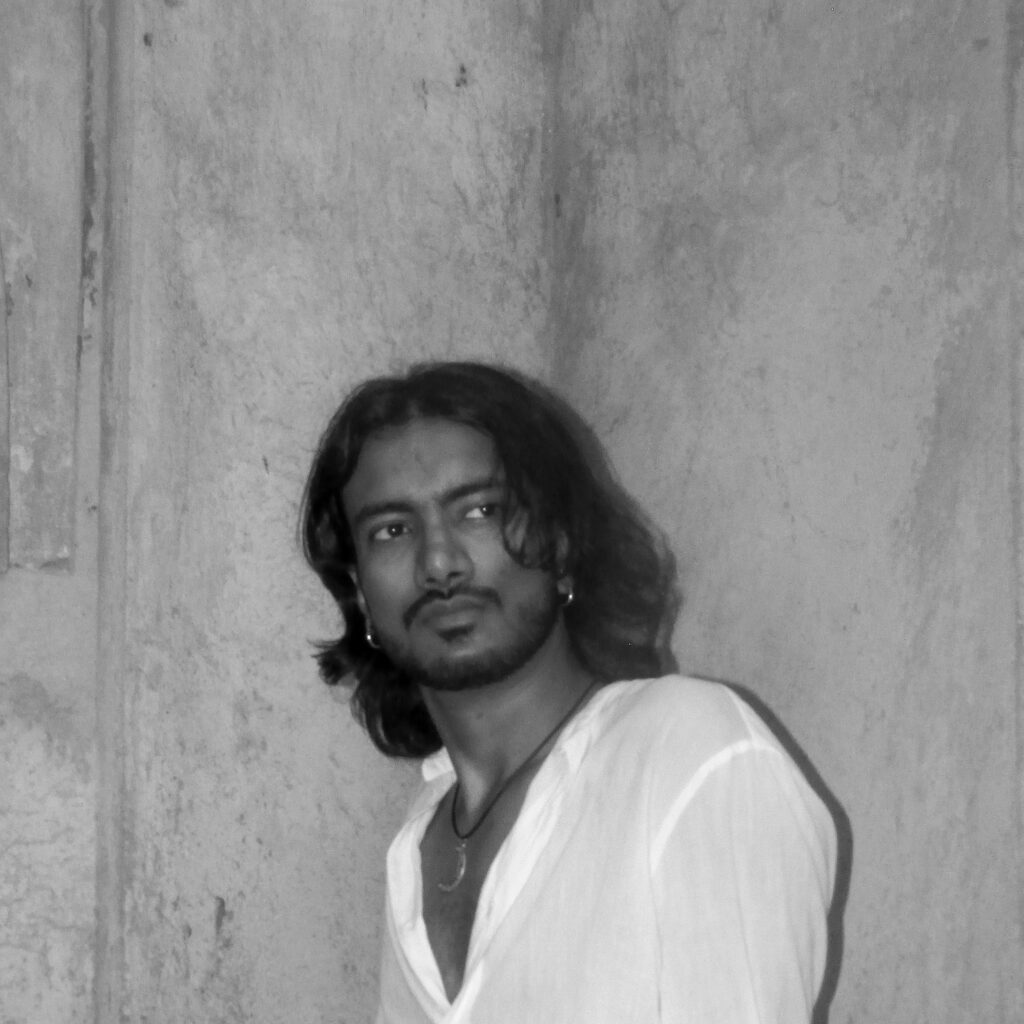
Mayank Rastogi is a poet, writer and editor who writes from wherever he can. He recently completed his Master’s in English from Jawaharlal Nehru University, Delhi. Primarily a poet, he has had works published by Indian Review, Zhagaram Literary, DoubleSpeak Magazine, Poems India, and Lekh Magazine, and is currently working towards completing his first poetry collection. Mayank is interested in the portrayal of the intersection between philosophy and the written word, interpersonal relationships and individual dissociations.
_________________________
Find MeanPepperVine on Instagram @MeanPepperVine