| Suchitra Sukumar | January 2026 | Short Story |
The butterfly counts not months but moments,
and has time enough.
Fireflies by Rabindranath Tagore
What one needs to know about Ramiah is that he is not made for the retired life, has never been, but everyone around him wants to behave like he is happy about it.
Which is why, every morning, Ramiah still rises at seven am. He still swings his bony legs off the bed, in one sporty motion, palm chastely bunching his lungi. Through half-open eyes, he still folds his blanket and lays it on top of the pillow, just the way his wife likes it, before sitting back down on the bed to wait for the signal from the kitchen.
The moment when the milk hits the sugar and filter coffee decoction is his cue. He heads into the bathroom and makes a quick job of brushing his teeth, spitting out blood-stained foam before gargling like a scooter with a flooded engine until the residual bitterness of last night’s cigarette leaves his mouth.
In the time it takes his wife to froth the coffee, he changes his banian–the only concession he has allowed himself in this new life-stage is not bathing as soon as he wakes up. This will be his rebellion.
This morning, he makes sure to avoid his wife Janaki’s eyes as he goes into the kitchen to pick up his coffee. Ever since his retirement began, she has made a daily habit of asking him for a large photo of Rama and Sita for their living room.
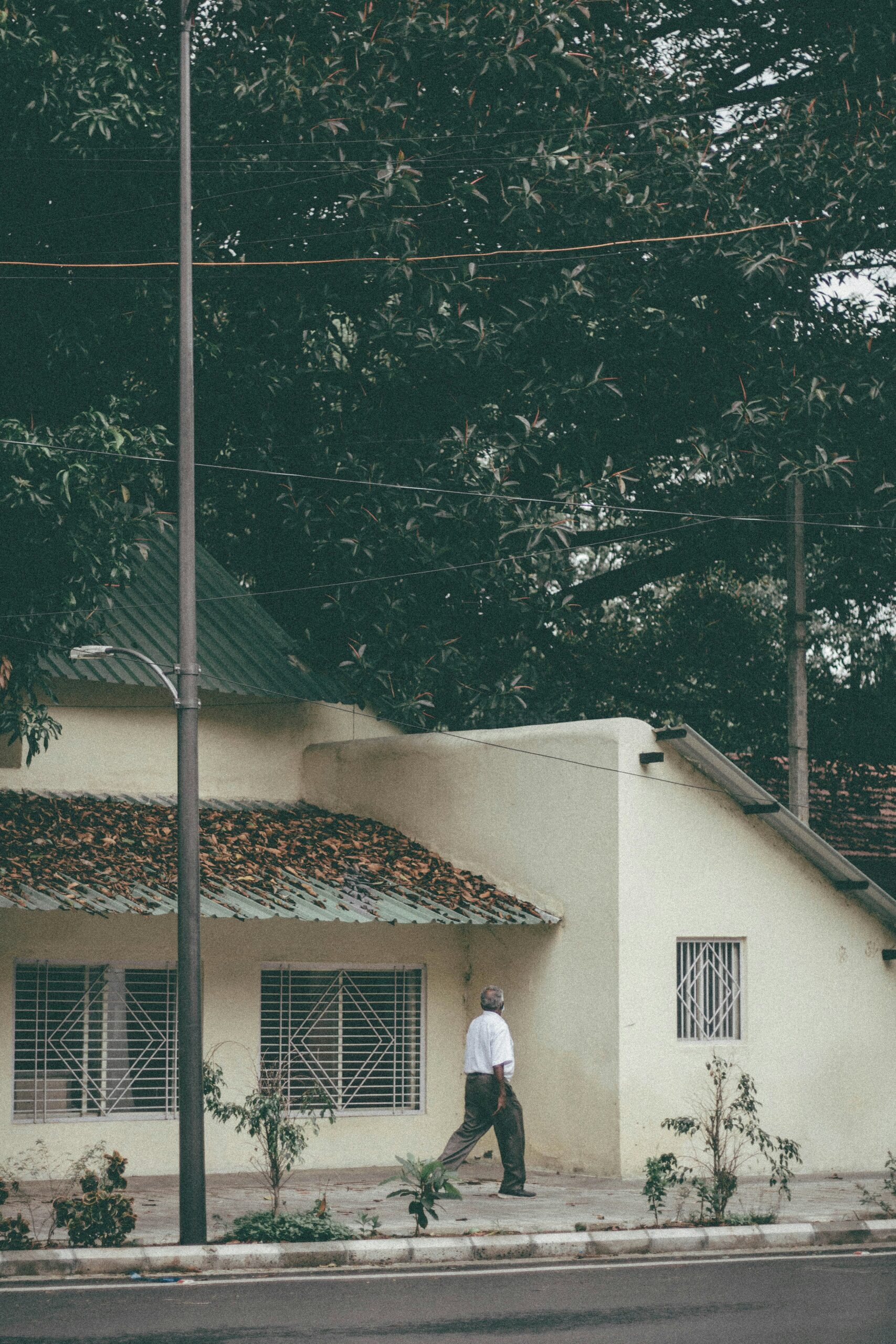
Cradling the hot tumbler in his palm, he frowns into the morning. Autos sputter and buses ply on the street outside. A young man’s motorbike rumbles, and Bangalore’s crisp morning air is shot through with the smell of petrol. For everyone but him, the day has begun.
He unlocks the main gate, and his frown deepens as he spots his neighbours performing their morning pranayama. As if with sudden inspiration, Ramiah breaks wind. From inside, he hears his twenty-two-year-old son Raghu remark to his mother, “Now we know where Appa is.” The sound of a playful slap follows. Ramiah spits over the compound wall into the gutter that runs alongside his tiny independent house.
A quiet gale rustles the dead leaves of his father’s beloved tulasi shrub. A crow, pecking at the fistful of rice his wife has left for it, stops to stare at him from its perch on the compound wall. Ramiah breaks eye contact with the bird, avoiding the memory of his father that will surely creep up. Crows are ancestors, after all. If he lets his attention drift, he tells himself, the bird’s presence will fade away, and with it will go all the times his father called him useless.
“Ree, thindi,” his wife calls from inside for breakfast. The last thing he wants to do is have breakfast with his useless son. He opens the rusted tap at the side of the house, fits the hose in, and begins watering the plants, starting with the sacred one. It looks as dull and brown as he is feeling.
The birds are loquacious, and the sunlight is warm on his hands. It feels unusual, as if he is playing truant from work. By now, he would be well on his way to the bus stop, heading to the post office, his workplace of the last thirty years.
On his last day at work, Ramiah had walked to his desk, placed his last ever packed lunchbox on the desk, and thought about how it would be the last time he would be donating it to his colleagues to have the roadside vendor’s egg biriyani instead. He’d sat on the metal chair, its worn plastic wicker feeling unusually uncomfortable. That day, his familiar, sorry set of customers–men and women who either couldn’t read English or found form instructions complicated–seemed somewhat atypical. He’d watched them as they pasted their oily foreheads on the half-raised glass partition, craning to see what he typed on his computer, indignation shining through their watery eyes, resignation writ deep into the lines of their faces. The realisation had crept up on him that the jig was up. It was the last day he would be on this side of the glass, the one insulation he had from facing the yawning gap that was going to be retired life. As if in agreement, the fan above him creaked in a steady rhythm, marking time’s arrow.
“Ree,” Janaki calls again. Water has pooled at his feet. He rushes to turn the tap off, his chappals sliding on the slick mud. Hurrying back, he skids, almost falling before he places both hands on the outer wall of his house to steady himself. Breakfast is semi-warm uppittu and pickle, which he wolfs down while ignoring his son.
After eating, he goes to the sofa and turns the TV on. Janaki brings him his second cup of coffee but holds it out of his reach, picks the remote up, and turns the TV off.
“In twenty-eight years, you haven’t given me a puja room. At least give me a good God photo so I can pray properly. I have never asked you for anything.”
“I am retired, Janaki. I have earned the right to watch TV whenever I please. Give it.”
A few moments pass in silence between husband and wife. Raghu clears his throat to break the silence.
“Other fathers usually do yoga before breakfast. They say that if you do pavana muktasana every morning, it will save the family members from your…”, he trails off and puckers his mouth, preparing to make fart noises. The pressure cooker hisses in the kitchen.
Ramiah springs out of the sofa, goes to his son, pinches his ear, and yells, “What did you say?”
Raghu jumps up and slinks away.
“Tell him not to speak to me until he has grown up. It’s all your fault,” Ramiah barks at his wife, ending the conversation in the way he always has.
Through the chatter of the morning news, he hears his wife slap Raghu, blaming him for the God photo she will never get.
This commotion gives Ramiah a strong urge to smoke. He steps out without bothering to change.
Right opposite the cigarette stall is a frame shop, showcasing life-sized posters of Puneet Rajkumar, a young-ish movie star who died recently. An accident at the gym. Ramiah is reminded of the joke he’d cracked in poor taste when the news hit. Flicking the cigarette into the gutter, he enters the frame shop.
“Yeshtu?”, he asks the shop owner, pointing to a 5-foot by 3-foot frame of a 3D Venkateshwara encrusted with diamonds and rubies.
“Seven thousand.”
Ramiah’s eyebrows climb his forehead. “Seven for that? Those diamonds are real or what?”
Another customer enters the shop. The shopkeeper walks to the same seven-thousand-rupee frame and says, “Done, saar. Told you it will look super!”
“Aye Ramu, hegidiya? You never came home after that first drink. What, you’re also buying a frame, a?”, the man speaks straight at him, ignoring the shopkeeper. Ramiah turns to face his neighbour, the one man he has nothing in common with apart from his name.
Ramachandra, the man who owns the corner plot, has two sedans and drinks ‘on the rocks’ single malt on his veranda every evening.
“Still thinking what to get. This is yours? Very nice, very nice. Great for living room,” Ramiah says.
“Puja room, da, not living room,” Ramachandra replies, winking. Ramiah snorts, pretending to understand. Then, turning to the shopkeeper, he points to the lavish large frame and says, “I want like this one only, but I will bring the picture for you tomorrow.”
As he walks back home, past Ramachandra’s gaudy corner plot house with its pink bougainvillea, Ramiah smirks to himself. The house is obscene compared to his humble two-room house with its tiny pergola of parijaata flowers that spill over the front gate.
Ramachandra’s driver is washing the two large sedans. Blue-black soap suds flow out onto the road, forcing Ramiah to jump over them to avoid getting his feet wet.
“Tchai, what a waste,” Ramiah mutters to himself. He feels proud that he has always been above such material desires, quite happy to be a middle-class man. He had never harboured any desire to have such a large bungalow, and he still doesn’t want it. Remembering Ramachandra’s living room with the boastful photo of Rama-Sita, he promises himself that he will never have something so large in his house. In fact, he decides he won’t regress into tradition at all. If he disappoints his dead father and Janaki, so be it!
He won’t be caught dead doing things like the other retired men on his street. The ones who wake the neighbourhood up with their morning kapalabhaati, tummies bulging like the throat sacs of frogs in mating season, except their expulsions are a chaste echo of the pelvic thrusts they’ve surely given up on by this age. No, Ramiah thinks to himself–he will never be like them. A family man, yes, but one who still thinks of his wife as his romantic partner.
The next day, Ramiah wakes up to texts from his former colleagues asking him to meet them at Sangeetha bar. Excited after many days of sulking, he goes to his barber of twenty years for a haircut. He lets the shop upsell a special facial and beard trim, but holds off on their offer to dye his hair.
“I don’t want to deny my age,” he tells the barber sagely.
As he leans back into the chair, one of those fancy ones that swivel without making him lose his balance, his mind replays the jokes and the latest gossip from work. When the barber shows him the mirror, he casts an appreciative eye on the clean shave and gelled hair. He caresses his head almost courteously, careful not to disturb the intentionality with which it has been set. But, just as he is about to return the mirror to the barber, he notices the crows’ feet around them, the little spots of skin that dot the bags. Before he thinks to resist it, his eyes note his scalp, visible behind his translucent cigarette-ash hair.
For the first time since his retirement almost two months ago, Ramiah boards the 45J from Basavangudi to Majestic. He watches the tall temples with piles of chappals strewn outside around Sajjan Rao circle go by, lets his eyes run over the cheerful blur of automobile repair shops on JC road, and by the time the bus turns towards the Majestic main road, a smile that has been building up inside him all the way from home emerges.
Majestic, despite the passage of time, looks unchanged. Majestic, no matter the stink and the noise, feels like arrival. His Majestic, which, after its brief dalliance with Hindi and English cinema, remembered itself and came back to Kannada.
He is at their choky old bar a full hour early. Going to their usual table, he waits for the bar owner to take his order, mentally practising the casual banter of the post-retirement questions. He decides that his story will be one of travel and leisure. He might even throw in a quip about his wife’s reaction to him buying an Enfield someday. After fifteen minutes, when no one has shown, he walks to one of the waiters. “Where’s Prakash?” he asks. They point to the framed photo of the deceased bar owner. It is a large 5-by-3, bedecked with gemstones and blinking lights.
His ex-colleagues troop in an hour and a half later, complaining of workload. They joke that if he were to ask for his old job back, they’d roll out the red carpet, not that he would ever want to go back there. Ramiah smiles and back slaps them, throws back a few bottoms-up of Old Monk, and reaches for the ‘touchings’ of pickle, to cut the burn of alcohol, with the practised hand of a regular drinker.
As the rum-haze sets in, his eyes wander to the framed photo. He remembers the stipple-faced man who couldn’t have been more than a few years older than himself. Prakash had friendly eyes, was quick to make conversation and happy to throw in an on-the-house once in a while. The photo in the frame, however, makes the man seem emotionless. The eyes are sunken, the moustache uneven, no gold chain, no folded palms displaying rings on each finger. The man has been captured in a checked blue and white shirt, his arms too close to his torso, shoulders holding tension like a twig about to snap. His weary eyes have a sort of knowing quality, as if holding in them the entire wisdom of a man’s life; from the innocent childhood days to the restlessness of youth, to the square shoulders of married life. The real irony, however, is the golden frame itself–the ones usually reserved for gods–like a last-ditch effort to overcompensate for the man’s sallowness.
It seems to him that Prakash’s eyes follow him as he walks out of the bar. The look that says, ‘I have known the battles of your adulthood, for I have felt them too’. As his group of merry colleagues walks down the Majestic streets, making ribald suggestions about the red light district, he feels Prakash’s eyes still with him. ‘I also know,’ he imagines the man saying, ‘the tug of yellow sarees and betel-leaf red tongues that sit indolent inside the mouths of whores, as they twirl the edges of their pallus, sizing you up to see if you would muster courage that night and knowing, even before you acknowledged it, that you won’t. No, not that day, and maybe not any day.’
As his colleagues giggle, debating whether to go for it or not, Ramiah thinks about his wife. He cannot remember the last time they’d been intimate.
When the plan to go to Vidhan Soudha is hatched, they hail autorickshaws. Too drunk to haggle, they pay one-and-aff. Ramiah sits at the outer edge, arms out, wind messing his gelled hair. As they near the building, he remembers his honeymoon trip, the one where he had offered Janaki long slices of totapuri mango sprinkled with salt and chilli powder, and responded to her blush by putting his arm around her. The memory of him handing her his first salary slides in next, followed by the puja when she is heavily pregnant, surrounded by her sisters. She had blushed for the second time.
A few days later, Ramiah walks home with two frames wrapped in newspaper. Janaki’s eyes gleam as he unveils the smaller one to reveal Rama-Sita.
“And the bigger one?” Janaki asks, surprised.
“Sit down,” Ramiah tells her. He takes his time unwrapping it, but Raghu rushes him, tearing off the wrapper to reveal a large, slightly pixellated print of their wedding photo in a two-inch-thick bevelled golden frame, with lights twinkling along the borders. Ramiah is hitting his son on the head when he hears Janaki gasp. Her eyes are gleaming, but she is blushing for the third time in her life.
Under their feet, the words: Ramiah weds Janaki, July 1997.
_________________________

Suchitra Sukumar is a self-taught writer based in Bangalore, India. She has published short stories in the Bombay Literary Magazine and Tasavvurnama. She is currently working on an adult fantasy novel. She pays her bills by running her own brand consulting firm. In her spare time she discusses philosophy with her two very wise dogs, reads, writes and collects second-hand books at an alarming rate.
_________________________
Ahhhh I was ready to hate him. But the end oh lovely!
Enjoyable and very well written. Loved the ending and the third blush 🙂
Reminds me so much of the old Bangalore as Ramaih negotiates retirement.