
| Sumanya Anand Velamur | January 2026 | short Story |
From behind, Kannan’s head resembled his torso. While a bald crown mirrored his shirtless back, the ivory-yellow of the tassel-like hair that skirted the top of his neck mimicked the worn-yellow of the veshti wrapped around his hip. His poonal—six, incestuous, browning-white strands intertwisting to form the unequivocal thread of caste entitlement—ran from left shoulder to right hip. He lay on the edge of his bed, on his right side. On his front, the thread escaped the pin of his right elbow, entwining with those emerging from the left shoulder, forming a noose somewhere close to his throat. His legs were bent at the knee. His hands, held together, cut through his veshti and were sandwiched between his knees. A Californian setting sun touched him red. He was asleep. To everybody around him, that is. In truth, his eyes were open to a slit, his vision made hazy by dense, greying eyelashes, and his ear perked up. He was watching and listening to all that was happening around him, his faculties sharp for a man of 82.
On the other bed in the room, directly opposite to him, sat two 14-year-old girls, backs resting on the headboard, heads bent over a mobile phone. Giggles bubbled frequently, punctuating their secret conversation. He could not hear what they were talking about. One was his granddaughter. The other was the most beautiful girl he had seen in a long time. She reminded him of Saroja.
***
Saroja, they said, was the most beautiful girl in the GK family, his father’s side of the family. On his mother’s side, no one spoke of beauty. It would have been considered an impertinence —vulgar even. But on his father’s side, they were wont to talk of these things.
“A prospective bride or groom should have any three of the following—beauty, money, intelligence, goodness,” his aunts concurred, passing comments on people’s appearance at family gatherings.
“He is so ugly. Good he has all that land. Otherwise, I don’t see who will marry him.”
“She is so beautiful. Do you know that the groom’s family actually asked for her hand in marriage? They couldn’t wait to have the girl’s family approach them. That’s how beautiful she is.”
“She wanted to marry him and only him. He was that good-looking! She was obstinate about it. Ottha kaal-la ninda, to marry him! They had to give in. Orey pidivatham, illai na! She would have thrown a tantrum, otherwise.”
It was mostly the women, his aunts and cousins, who spoke this way. But the men, with their quiet smiles, provided their approbation to the topics of conversation. Sometimes, an ill-considered giggle would escape one of his otherwise stoic male cousins.
Once, he overheard his aunts talking.
“Yeah! What a tragedy! Such a handsome man at that, too!”
They were talking about a man who had lost his wife to cancer.
“Obviously, such a handsome man needs a partner. What a tragedy!”
All handsome men needed a partner. And the corollary, not-so-handsome men could do without.
On his father’s side, they said that he, Kannan, was the most handsome amongst the men and Saroja the most beautiful amongst the women. His youngest aunt would make coy eyes at him when she said it. Not only did handsome men need a partner, they also deserved the most beautiful. Saroja was his cousin, his father’s sister’s daughter. It was a relationship that allowed him to think of Saroja as a prospective wife. If all handsome men deserved beautiful women, Saroja was logically his.
Saroja was 12 when he was 17, and Kannan had already built a future in his head with Saroja in it. She was too young to think on these lines. And he too was busy working towards an engineering degree in Guindy Engineering College, a part of the future that felt less guaranteed to him.
When he was 24, he overheard two of his aunts talk about Saroja, soon finishing her graduation, requiring an alliance, a good-looking boy to complement her good looks and one that had a good inheritance or at least good prospects. Kannan had to act immediately. He told his parents that he was interested in marrying Saroja.
His mother screwed up her face.
“Are you sure? She is too independent minded.”
“Yes. I am sure. She is beautiful.”
“Beauty can be a liability.”
“I am handsome. We are meant to be together.”
“That’s not how these things work.”
His father, on the other hand, was extremely happy at the thought of his son marrying his sister’s daughter.
“Saroja is perfect. What a lovely addition to the family. I will take the proposal to Akka and Athimber immediately. We should have the wedding before the year is out.”
Enthusiastic Appa dragged a sulky Amma to Saroja’s house. When they came back though, Amma had an irrepressible smile on her face. Saroja had walked in as soon as they had made the proposal to her parents. And without any regard for the elders in the room, she had charged towards her uncle, “I am sorry. But I will have to reject your proposal. I do love your son. But only as a brother. Nothing more.”
Is loving a brother all that different from loving a husband? Can’t one form of love transform into another? It must happen all the time in arranged marriages when suddenly one is made to think of a cousin in a new light. If one tried, one could love a brother like a lover, surely. If it was a lack of effort, why? Why was she not willing to make the effort? Did she have another lover? As far as he knew, there was no marriage-appropriate cousin on either her mother’s side or her father’s side. Did she take a lover from outside? Was it someone in her college? But hers was a girls’ college. Maybe she found him on the bus to and from college. It seemed rather flighty for the likes of Saroja to develop a lover in a public bus. Maybe it was a friend’s brother? Kannan knew that a lot of love developed that way—with either a friend’s brother or a brother’s friend. Saroja did not have a brother. And then it occurred to him it could be at The Club where Saroja went every other week. Maybe there was an age-appropriate man there. Maybe he had captured her heart. There was definitely a lover. But where? How? And was he as handsome as Kannan? Unlikely. But he must have something, surely. Maybe he was rich. Maybe he was very intelligent and had great prospects.
He didn’t have to speculate for long, though. Saroja’s wedding was fixed soon after. And it wasn’t even a lover. It was an arranged marriage. Vishwanathan was from the same college as Kannan, a couple of years his junior. Saroja’s fiancé was anything but handsome. He was not particularly well-to-do either. Kannan was convinced that Saroja must regret rejecting his proposal. So confident was he that a mistake was about to take place, that he walked over to his aunt’s house, and on finding Saroja alone at home, he told her that he was still willing to marry her if she wanted an excuse to extricate herself from Vishwanathan.
Saroja looked annoyed.
“I have made up my mind about marrying him. I really do like him. If I were you, I would stop this line of conversation immediately, because it is extremely condescending.”
Condescending! What did that even mean? He was being kind and sensitive. She was simply cutting off her nose to spite her face. And she seemed to be proud of it too.
“Is it because he is going to the US soon?”
“Oh, for god’s sake, stop, Kannan Anna. You are insulting me with every sentence.”
“But you don’t even know him. The little conversation you have had is under the supervision of your parents and sundry other family.”
“No, that’s not true. I spent an evening with him when he picked me up in college, and we walked the length of Marina Beach twice over. We ended that evening eating corn on the cob.”
“Still. Is that enough time to know a man?”
“I know enough of you to know that I don’t want to marry you.”
Saroja moved with her husband to the US, only to be seen occasionally when she came to the country, looking resplendent and happy.
***
This girl, the one sitting in front of him with his granddaughter, looked like Saroja. Like her, this child was lissom, had the same caterpillar-like eyelashes, luminous skin and a pair of tulip lips. Her name was Candice.
Candice was the only one of his granddaughter’s friends who acknowledged his presence with a smile. Her friends, who visited, ignored him most times while some would nod in his direction, an awkward shake of the head that didn’t say much. All he interpreted in that nod was, “ Hello there, other living being in this room. You are still alive!” or “Hello there, other living being in this room. You are still alive?”
Both intonations, he resented.
But Candice would smile. She would say, “Hello.” She would ask how he was like she meant it. And sometimes, Candice would include him in conversations.
“I think we should go to the mall and check out the latest movie.”
“But we could also just watch something on Netflix.”
“What do you say, thatha? Mall or Netflix?” Addressing him as grandfather like his granddaughter did, she held out two fingers, urging him to grab one, pointing towards the right with her eyes.
He did as her eyes bid him. And the two girls were off to the mall.
***
In 1972, around ten years after Saroja married Vishwanathan and about seven years after Kannan’s own wedding to Raji, Kannan visited the US. The initial disappointment of not marrying Saroja was short-lived, and when Raji came along, Kannan thought her good-looking enough to be seen alongside him. She took on the role of wife with a zeal that left nothing wanting on the domestic front. Outside the home, his career as an engineer with a home-grown motorbike company took off to phenomenal heights.
In 1972, the company sent him to Charlotte, North Carolina. That was the first time he visited the US. After finishing his work in Charlotte, he spent a week visiting family in other parts of the US. Raji said he had to visit Paddu Uncle in New York. And his father said he had to visit Saroja in Bridgeport, Connecticut.
It was June, and the trip was scheduled for October. Raji was nervous.
“You will need warm clothes. I will write to Saroja and ask her what to buy for the cold. Don’t want you freezing!”
A fat envelope, stuffed with airmail, tissue-thin paper with a multitude of questions, was dispatched promptly. Five weeks later, in return mail, an envelope twice as bulky made its way home. Saroja had provided detailed responses.
Connecticut, in October, will be cold. As will New York. North Carolina will be warmer. But it will still be cold for a man coming from Madras. He will need a good woollen jacket, one that he can use both for formal and informal gatherings, a few sweaters to go with the different clothes he wears, a muffler and a hat…Anyway, muffler and hat I can provide. And he hopefully will not need them in Charlotte. He will need a couple of sets of thermal wear that he can wear inside his clothes.
You should get all your woollens at Joonus Sait and Sons in Evening Bazaar Road, in Parrys. Tell them that I sent you. Tell them you are visiting me. Give my full name. That is Saroja Vishwanathan. Not my maiden name.”
Much of the letter was about this. The rest of the letter was about food.
Pack for Kannan Anna dry mixed rice like puliyodharai and lemon rice for the flight. Airlines food is horrible. In the US, Indian restaurants usually serve Punjabi food. New York might have South Indian restaurants or at least, Srilankan Tamil restaurants that serve our kind of food…vegetarian food is very difficult to come by. If he is sure of having a hotplate in his accommodation in Charlotte, you can send some rasam powder and sambar powder with him. And write down the recipes for both so that he can use them.
Raji got to work. She made several trips to Joonus Sait and Sons, and a couple of times, he had accompanied her as well. She made packets of masala powder and sealed them in plastic bags with the flame of a candle. Only once did he hear her grumble, “The way you are so detached from these preparations, one would think it was I who was going to the US and not you.”
He, on the other hand, was preoccupied with wondering about Saroja. How did she live? When she visited every other year, he saw her briefly, with the backdrop of the extended family. But now, he would see her in her own turf; see the life he might have had if he had married her.
When he got off the Greyhound bus at Bridgeport, he found Saroja walking towards him, looking sharp in a pair of black pants, powder-blue turtleneck sweater and a long woollen coat, the dual ink-blue and purple colour of the Nagapazham. She also had on a very becoming baby pink knitted hat topped with a whitish-grey pom-pom that made her look at least ten years younger than she was. “Hasn’t aged a bit!” he thought to himself and was surprised to detect bitterness in his own mind-tone. Raji hadn’t fared very well over the years. The heat and grime of Madras and the work involved in bringing up two children (the last two were yet to be born) had taken a toll on her. In bed, she smelt of spices, and not in the sexy cinnamony way but in the pungent asafoetida way. Saroja, on the other hand, issue-less, was well preserved by the cold.
Right behind Saroja, there walked Vishwanathan, packing away the car keys into his pocket and looking at some other Greyhound, blindly following Saroja, proving himself to be the numbskull Kannan knew he was.
“Hi Kannan Anna! So good to see you here. Vish will bring the car around.”
Vishwanathan was in a steady job, and Saroja spent her time doing embroidery and reading for a book club she helped start. She had the time to show Kannan around the city while Vishwanathan was in office. They drove around, ate at famous restaurants, visited museums, and took long walks in parks. They spoke of their childhoods in Madras over coffee and cake. Unlike his life back home in Madras, it was a relaxed time. He never got time with Raji these days, what with her chores around the house and the kids. And some nights, when he was in the mood, and he let it be known to her, Raji just hitched up her sari to her knees and lay down, her pallu still wet from the constant wiping of wet and grimy hands.
***
He was not new to this pretending-to-sleep business. He remembered the exact moment when he started doing it. He lived in the big house in Madras for a few years after Raji had passed in her sleep, after ensuring all four children were well settled either in jobs or in marriages. In death too, she had been considerate and not given any trouble. He was left in the big house, to his own devices. Three of his brood of four were settled in the US. Only his eldest daughter lived in Madras now and would look him up every fortnight.
“Appa, I know the maid comes and cleans every day. But do you see the grime that collects on the dining table? Once you eat, can you not wipe the table? You are not so old or infirm.”
It was true. He was not yet 70. And he had no major ailments, save Diabetes.
“Appa, your cough syrup has spilled on the kitchen counter. It takes two minutes to wipe it away. Look at the ants swarming around now.”
“Appa, how long does it take to keep the clothes that have been brought back from the dhobi. You just need to open your cupboard and shove it in.”
He soon noticed that every time she said “Appa” a certain way, a scolding was imminent. At first, he was irritated.
“Appa! Don’t get irritated with me. I am just telling you how to make your life simple.” She raised her voice. “And mine too!” she added in a mumble.
Then, he realised that she wouldn’t be able to scold him if she knew he wasn’t listening. That’s when he started pretending to sleep.
He would open the door, greet her, and ask after her husband and kids. Then, as she started picking her way around the house, he would pretend to read the newspaper. In two minutes, he would let the newspaper drop on his nose and pretend to be asleep. She would come into the room with “Appa” and would see the newspaper buoyant with his breath. Her complaint unregistered, she would turn back to do what she was doing before. Sometimes she would get calls. He would listen in on her end of the conversation. Most times, it was the kids.
“ Where is my geometry box?”
“ Can I stay at Ajay’s for a sleepover?”
“What are we having for dinner? Can I order pizza?”
He divined these questions from her responses. Sometimes, it was a friend or a relative. And she would have long, gossipy conversations. He was aware that while nothing earth-shattering was being discussed, much of this conversation would have been truncated if she had known that he was actually awake and conscious of what was happening around him.
One day, her phone rang.
“Hi Anna! How are you?”
A sibling conversation.
“I am good. I am at Appa’s, actually. Putting away his things. How come you aren’t asleep? Isn’t it some 2 AM in Texas?”
“Ya ya! I understand.”
“Let me speak to Karthik and get back to you.”
“Give me until the end of day.”
“What else? How are Kavita and the kids?”
“ Oh, that’s good. Congratulations to her.”
“Here? Nothing to report. The house is filthy. He sleeps a lot. In fact, I hardly see him awake these days.”
“Yeah, one of these days, we should all get on a call and have a conversation about this. I feel like we need to hire a full-time help for him. I don’t think he will manage.”
“Yeah. Let’s see. Let me make enquiries.”
“I don’t know how he will like that kind of change. But maybe he needs to be prepared for it eventually, so now is better.”
The conversation was mostly obscure, but at the part where his daughter was speaking about him, Kannan’s ears had perked up. He wanted to know more. Automatically, his eyes opened a peep, and he saw Page 4 of the newspaper at close quarters. Opening another sense did not clarify things for him. So he shut his eyes again with a feeling of irritation. After that, he always allowed the newspaper to fall on his chest, leaving him a clear line of vision.
This worked wonders, he realised. And when his eldest son told him that it was impossible now to take care of him in this huge house, and that he needed to move to his house in Dallas, he was somewhat ready. When the eldest son, wife in tow, came all the way from the US to strip his house down and pack him off to the US, he was more than ready with practice.
Away from his home, his city, his life of 75 years, pretending to sleep progressed from being Kannan’s source of entertainment to being his route to divine the world. Dallas, New York and San Francisco had become his life, moving from one home to another, melding into different lives every six months or so. He practiced and perfected the art of pretending to be asleep. All the time he pretended to be asleep, he overheard bits and pieces of conversation, looking through greying eyelashes, and piecing together an increasingly unfathomable world, one in which he was never invited to participate. A recent addition to his repertoire was a low whistle at regular intervals to give the impression of a wheezy snore.
***
“Would you like some liquorice?”
Candice held out her hand with three brown cylindrical things that looked like chocolate. He put out his arm to take one, and his granddaughter’s voice came hurriedly, “Hey! Don’t offer him things to eat without checking with my mum.” Candice snapped her palm shut with an “oh” followed by a giggle. Kannan’s face furrowed in annoyance.
Candice took a seat on his granddaughter’s revolving chair-on-wheels, the one in front of her desk. With one leg up on the bed, she propelled herself back and forth, the seat tracing a half-circle. Kannan forgot his annoyance and looked at her as if he were looking at Saroja at 14.
“Did you speak to your mum about sharing the room?” Candice asked her friend, gesturing towards him with her eyes.
“Yes, I did! Mum agreed. It’s creepy. I will get the room to myself soon. She promised.”
The vision in front of Kannan shook—like a TV screen whose antenna had shifted away from optimum reception. Indignation flooded his being. He closed his eyes, this time in earnest.
_________________________
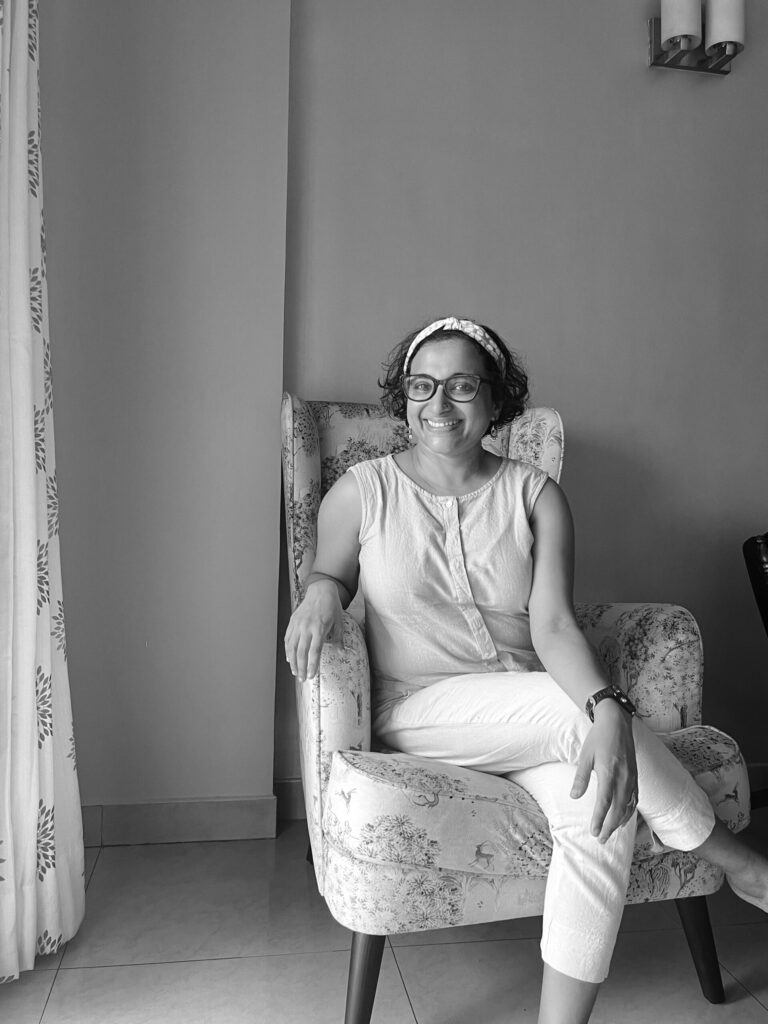
Sumanya Anand Velamur is a researcher, social worker, impact consultant, and writer. She is based in Bengaluru, where if she is not tucking into some good food, she can be found at her desk, writing, reading about writing, and researching for her writing. Her fiction and non-fiction works have been published in Kitaab, Feminism in India, Mean Pepper Vine, USAWA, Out of Print Blog and Quillmark. Her stories were shortlisted for the Deodar Prize, 2024 and the BWW R.K.Anand Prize, 2024.
_________________________
Photo by Raja Tilkian on Unsplash
Find MeanPepperVine on Instagram @MeanPepperVine
Enjoyed reading this. Lovely writing and detailing.
thank you so much!
Good reading after a long time Sumanya👌particularly loved the way you described the psychology of a man in his 70s, knowing that you are so much younger ! Hope to see you winning big time !
thank you for your kind words, aunty!